
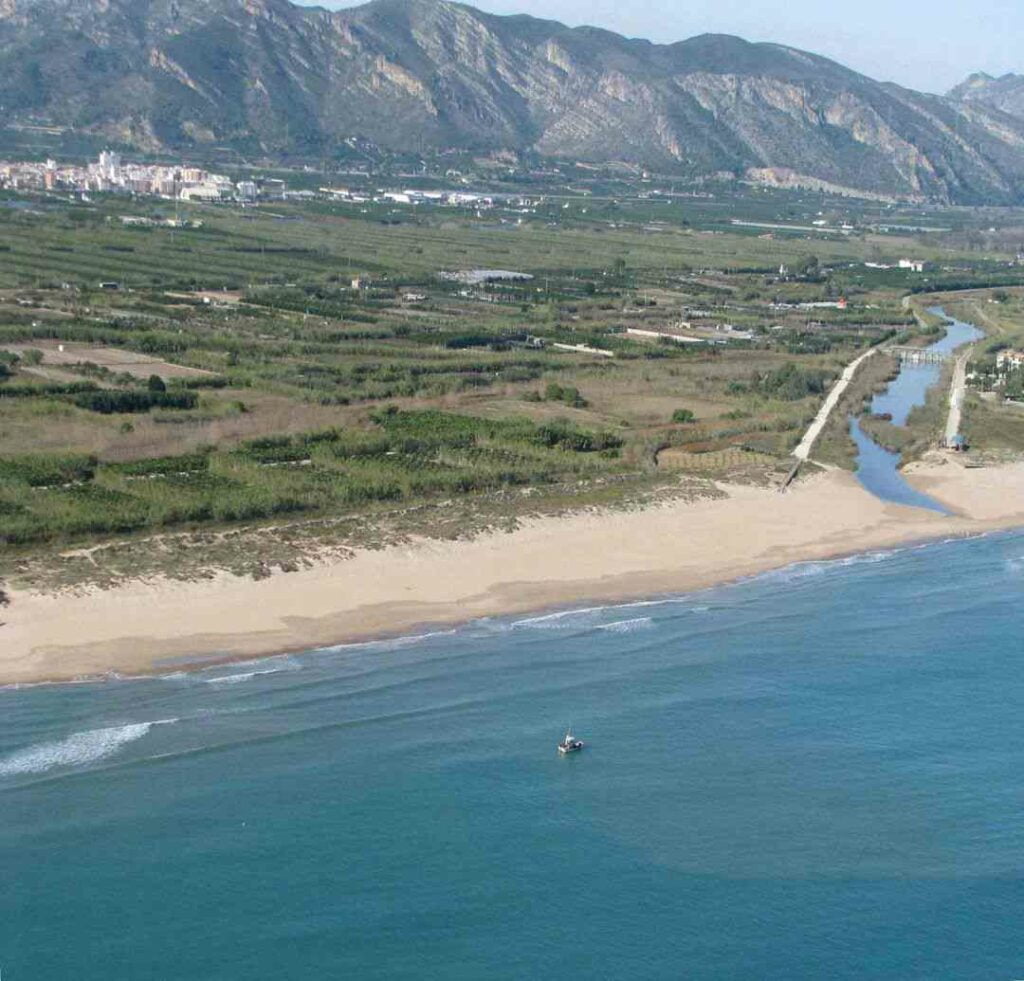
L’Ahuir Beach is the great natural stretch of sand on Gandia’s northern coast: almost two kilometres of open shoreline, a protected dune ridge and authorised naturism. Its landscape is very different from neighbouring Nord Beach and should be explored using the boardwalks and respecting the signs.
Contents
The regional tourist information uses l’Ahuir, while municipal sources and Valencian maps also use l’Auir. Both names refer to the same stretch of coast; this guide uses l’Ahuir because it is the variant most commonly searched for.
Where L’Ahuir Beach is
The beach begins north of Gandia Beach’s built-up area, joins Nord Beach at its southern end and extends towards the mouth of the River Vaca and the boundary with Xeraco. Gandia’s 2024 Beach Sustainability Report gives a length of 1,850 metres and an approximate width of 120 to 150 metres.
There is no promenade or continuous row of seafront buildings here. Farmland appears beyond the dune ridge. The lack of development accounts for much of its peaceful character, although some summer weekends are busier.
The dune ridge, coastal barrier and marshland
Wind-blown sand forms embryonic, mobile and fixed dunes. Their vegetation is adapted to salt, sea winds and moving sand. This is not a “coastal forest”, but a collection of sensitive dune habitats that stabilise the sand and shelter specialised wildlife.
The sandy ridge forms part of the protected Dunes de la Safor area, designated a Special Area of Conservation. Most of l’Ahuir is classified as an N0 natural beach, the highest level of coastal protection in the Valencian Community, while the southern end is an N1 transition sector. These designations apply to the dune system and defined areas, not identically to the whole bathing zone.
The coastal sand barrier separates the sea from the wetlands farther inland. Gandia’s marshland lies behind it; it does not form within the beach. Understanding this sequence —sea, sand, dunes and wetland— helps visitors appreciate La Safor’s coastline without confusing different ecosystems.
Kentish plovers and conservation
The birds that use this habitat include the Kentish plover, which nests directly on the sand. Sensitive areas are marked off during the breeding season and cleaning close to the dunes is carried out by hand. Ropes and low fences protect nests that can be very difficult to see.
Wooden boardwalks provide access to the beach without crossing the vegetation. Leaving them, walking over the dunes or entering a cordoned-off area accelerates erosion and may disturb nesting birds. The best photographs are always those taken from the permitted route.
The naturist area: is this a nudist beach?
L’Ahuir allows authorised naturism and is recognised as one of the naturist beaches in the Valencian Community. This does not mean that its entire length is exclusively for nude bathing or that the naturist section is two kilometres long. It is a shared space: follow the seasonal signs and show the same consideration to naturist and non-naturist visitors.
How to reach the beach
The official access reference is Carrer Ribera Baixa, s/n, at the northern end of the built-up area. The beach can also be reached on foot from the Xeraco boundary. In both cases, use the designated boardwalks for the final approach to the sand. Do not rely on a particular bus route or car park without checking the current season’s information first.
See L’Ahuir Beach on Google Maps. On busy days, arrive with time to spare and park only in authorised areas.
Seasonal services and safety on an open beach
Tourist and municipal information lists boardwalks, bins, showers or foot washes, beach surveillance and lifeguards. Their installation and operating times are seasonal, so visitors should not assume that every service is available all year or at every point along the beach. Check the official information before travelling.
L’Ahuir is an open beach and sea conditions can change. Always follow the warning flags, lifeguard instructions and the markers for any water sports. A sandy, gently shelving profile does not guarantee safe bathing for children or inexperienced swimmers.
Restoring the dunes
In November 2025, Spain’s Ministry for Ecological Transition approved the first phase of a dune-restoration project for Gandia and Xeraco, published in February 2026. It includes removing non-native vegetation and unsuitable elements from the dune system; some access points may change temporarily while work is under way.
Rules for a responsible visit
- Use the boardwalks: do not cross the dunes or tread on their vegetation.
- Respect fenced areas: they may protect Kentish plover nests and regenerating dunes.
- Do not enter with motor vehicles: follow the pictograms and signs at each access point.
- Take all rubbish away: a natural beach will not always have a bin nearby.
- Avoid smoking: l’Ahuir is listed as a smoke-free beach and cigarette ends are particularly harmful litter.
- Check the current rules: services, access with animals and sports activities can vary from one season to another.
Places to visit near l’Ahuir
A visit can be combined with a walk around the Grau de Gandia or a trip to the Alqueria del Duc and Gandia’s marshland. These nearby landscapes tell different parts of Gandia’s relationship with the sea, wetlands and seafaring life.
Official information before your visit
Check the Turisme Comunitat Valenciana listing for L’Ahuir Beach and Visit Gandia’s information to confirm access, services, surveillance, certifications and any temporary restrictions.