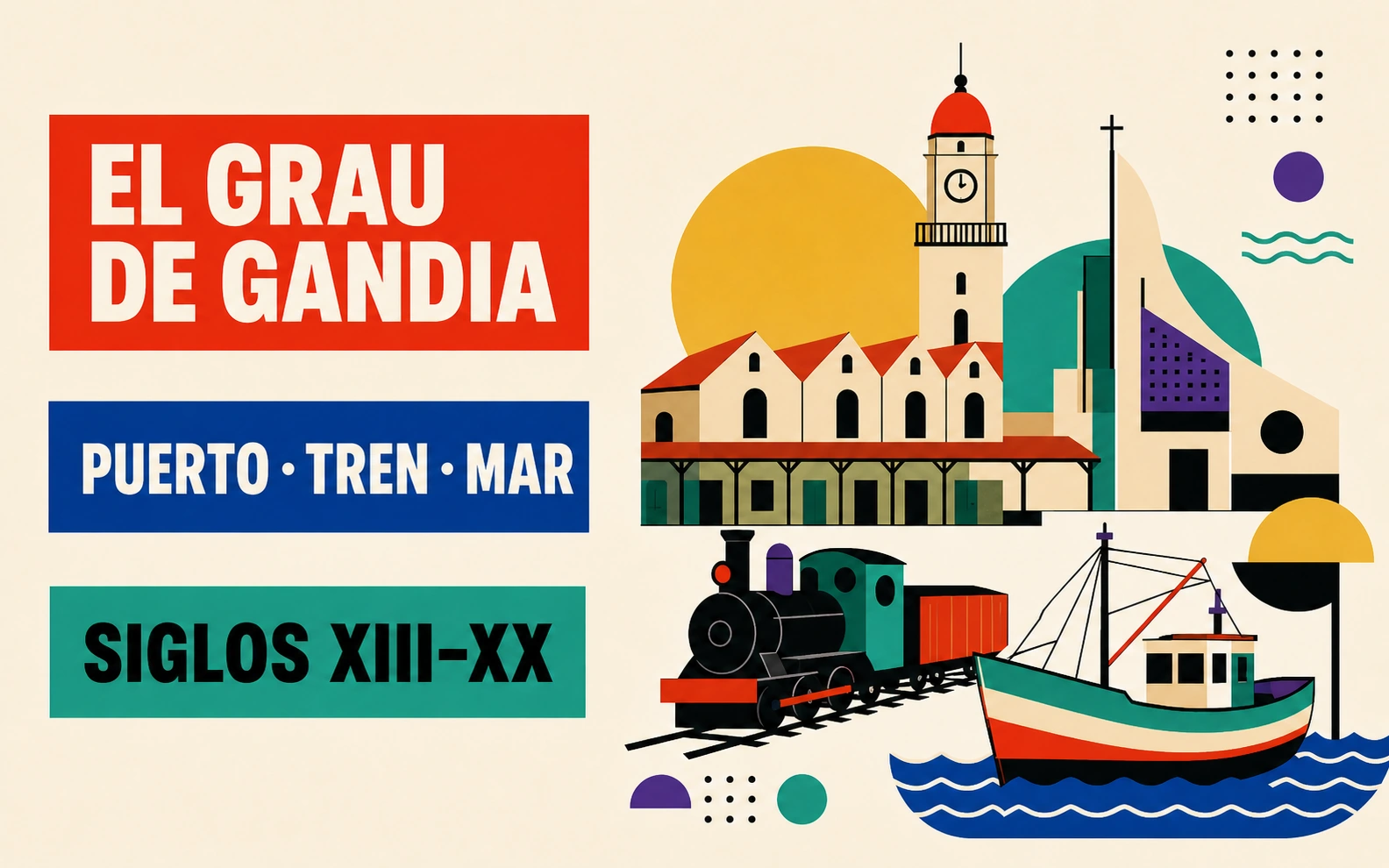
El Grau de Gandia is more than the district connecting the city to the Mediterranean. Its port, the former Alcoy railway, fishing, fideuà and a church designed like a ship on the water all tell part of La Safor’s history.
Contents
Three kilometres from the historic centre, between the Sant Nicolau ravine and the mouth of the River Serpis, El Grau grew facing two landscapes: the open sea and the market gardens. Its development adds a maritime, industrial and popular perspective to the history of Gandia.
From a medieval landing place to a seafaring community
For centuries, the settlement was arranged along both sides of the Sant Nicolau watercourse. On the southern bank stood the Casa del Grau de la Mar, associated with coastal defence, customs and the storage of goods. On the northern bank, the Casa del Llavador was used to wash wool for the medieval textile trade.
The Casa del Grau included a defensive tower, quarters for the garrison and a trading depot where goods were inspected and stored. Across the water, the wash house formed part of a productive landscape documented since the Middle Ages. The old coastal tower survived until 1888, when it collapsed after centuries of exposure to wind and salt.
Small-scale fishing and coastal shipping sustained a modest community. In around 1831, only 140 to 150 people lived there. That scale changed dramatically when orange exports required a safe harbour and the factories of Alcoy needed to receive coal by sea.
Before the port was built, much of the fruit was carried in barges to ships anchored off the beach. The swell made every shipment difficult and expensive; transporting such a delicate product overland to Valencia was no better. Spain’s Port Act of 1880 opened the way for a privately backed facility.
The British port and the tren dels Anglesos
Engineer Rafael Yagüe signed the port project in 1883, and the first stone was laid in 1886. Three years later, the British-owned The Alcoy and Gandia Railway and Harbour Company Limited acquired the rights to the port and railway. The harbour opened to the public in 1892.
The combination was remarkably effective: ships unloaded coal for Alcoy’s industries and took on agricultural produce from La Safor; the narrow-gauge railway ran for about 53 kilometres and reached the quay itself. Gandia thus had Spain’s only privately funded port built to provide a public service for ships, goods and passengers, as well as one of the country’s earliest examples of intermodal transport.
The port and railway transformed the scale of El Grau. Stevedoring, warehousing and support trades expanded as oranges connected the region with European markets. In 1934, Gandia became Spain’s second-largest fruit port, handling around 250,000 tonnes.
The port passed into state ownership in 1946–1947. The railway closed in 1969, but its memory lives on in the «Villalonga» locomotive in the Parc de l’Estació and along part of today’s Serpis Greenway.
Fruit sheds, fish market and maritime culture
The fruit sheds, Torre del Reloj, fish market and quays still make that transformation visible. Alongside commercial traffic, El Grau retained a distinct fishing identity linked to bou trawlers, the fish auction and a cuisine born from long days at sea.
The present sheds began to be built in the early twentieth century to store thousands of boxes of oranges. Their vaulted buildings form one of the port’s most recognisable ensembles; the central tower, with clocks on all four sides, eventually became an emblem of El Grau. The complex has been recognised as a Local Heritage Asset since 2018.
Tradition places the birth of fideuà de Gandia aboard the Santa Isabel in the early twentieth century, when noodles replaced rice in a fisherman’s meal. Beyond the exact date and the details passed down orally, the dish encapsulates the relationship between El Grau, its fishing fleet and the cuisine of the whole city.
San Nicolás and the new twentieth-century landscape
The port’s great modern landmark is the church of San Nicolás de Bari. Designed in the late nineteen-fifties by Gonzalo Echegaray with the involvement of Eduardo Torroja and Jaime Nadal, it opened in 1962. Its trapezoidal plan and unsupported concrete roof reinforce the image of a ship moving into the harbour basin.
During the same decades, the first villas, hotels, apartment blocks and promenades turned the coast into a tourist destination. El Grau did not abandon its past: it incorporated it into a new residential and holiday landscape where the commercial port, fishing, university, gastronomy and seafront coexist.
The change had earlier roots. First came the marells, small agricultural properties where some families spent days beside the sea; then came the holiday villas of the 1920s to 1950s. From the late nineteen-fifties onwards, hotels and apartment blocks extended activity towards the beach and multiplied the seasonal population.
What to see to understand the history of El Grau
- Moll dels Borja and the harbour promenade: the best route for seeing the relationship between the city and harbour basin.
- Fruit sheds and Torre del Reloj: reminders of fruit exports and the industrial past.
- Fish market and fishing quay: the continuity of maritime work.
- Church of San Nicolás: modern architecture facing the water.
- Breakwater and lighthouse: a complete view of the port and coastline.
For a longer visit and more information on the port’s heritage, see the official El Grau and beach route. The history published by Valenciaport provides further context on the origins of the harbour and railway.