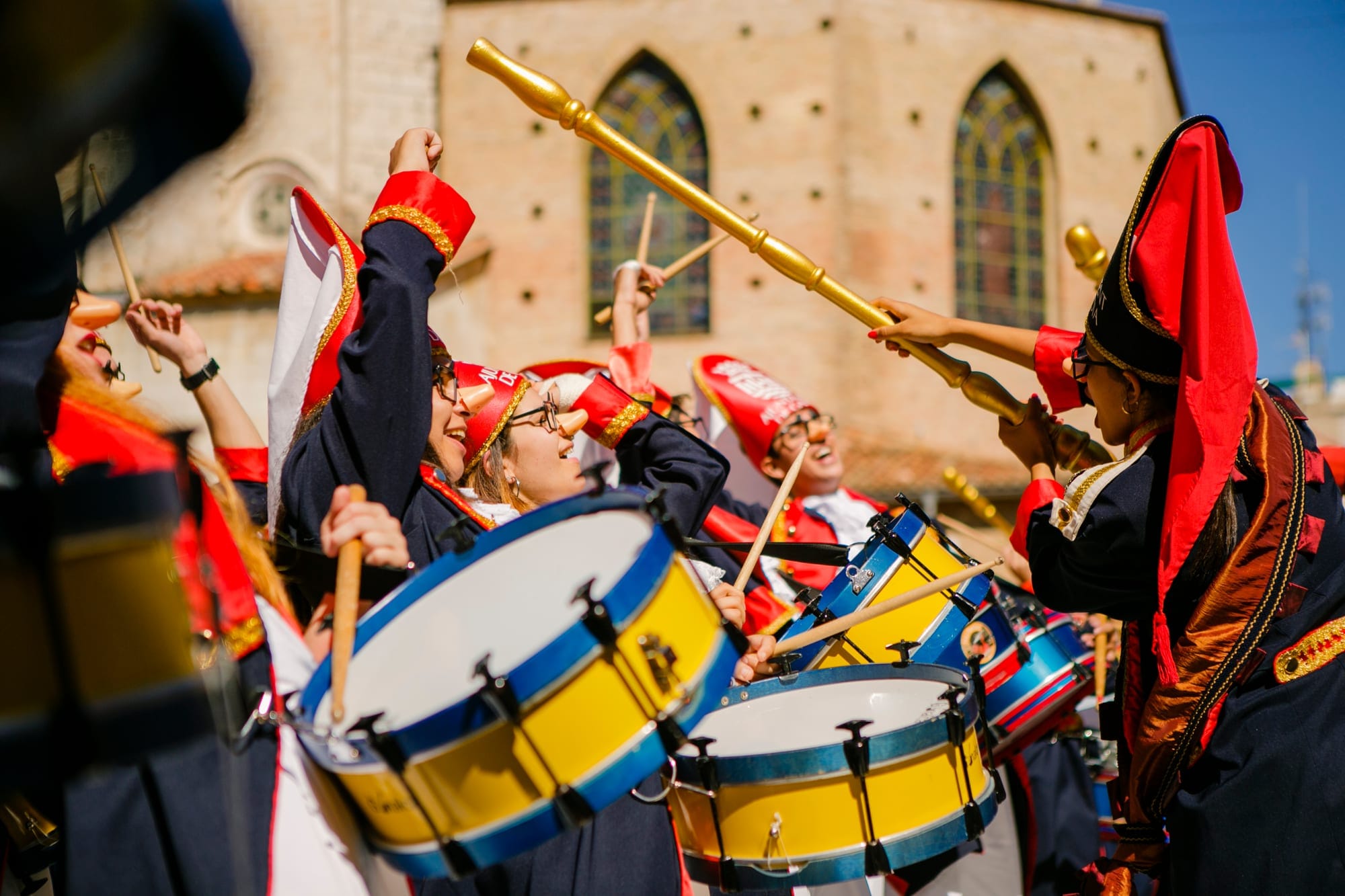
The Tío de la Porra de Gandia is one of the city’s most beloved symbols and the most recognisable sign that the Fira i Festes is beginning. Drums, dark glasses, a fake nose and a golden truncheon turn this tradition into the perfect scene for understanding Gandia’s festive spirit.
Contents
For anyone visiting Gandia for the first time, the Tío de la Porra is not just a picturesque street parade. It is the popular start of the patron saint festivities, a tradition with a history spanning over a century and a half that blends humour, percussion music, school memories and local heritage.
What is the Tío de la Porra
The Tío de la Porra heads a drum band announcing the start of Gandia’s Fira i Festes. His appearance is unmistakable: a military-inspired uniform, dark glasses, a fake nose, a theatrical expression and the golden truncheon that gives the character his name.
The event was declared an Intangible Asset of Local Relevance in 2012, a protection recognising its value within Valencian festive culture. The heritage order itself describes it as a grotesque drum band that roams streets and schools on the first day of the fair to announce that the festivities are beginning.
When to see it in Gandia
The key moment arrives on the first day of the Fira i Festes, which usually falls between late September and early October. The programme changes every year, so before organising your visit, it is worth checking the official Fira i Festes de Gandia website.
The most highly anticipated scene takes place in the morning, when the bands depart from Plaça Major and parade through the city. One of their most special stops is at the local schools: there, the tradition of the “school release” continues, a symbolic gesture where the Tío de la Porra announces to the children that classes are suspended and that the fiesta is already in the streets.
A tradition rich in history
The tradition has deep roots in 19th-century Gandia. The research cited in the heritage declaration links its origin to the drum major of the National Militia, a figure who communicated official announcements in a city still shaped by traditional forms of urban life.
Over time, that solemn announcement transformed into a satirical troupe. In 1871, it appeared linked to the old “Figurón”; in 1929, the grenadier uniform became established; in 1931, the popular name Tío de la Porra appeared in the festival programme; and since 1934, its entry into schools has been documented.
Why it catches so much attention
- The mask: dark glasses and a fake nose disguise the participants and reinforce the theatrical tone.
- The percussion: bass drums and side drums announce the fiesta even before the procession comes into sight.
- The golden truncheon: functions as a baton of command and embodies the ceremonial image of the character.
- The community involvement: students, senior bands and local groups keep alive a tradition recognised across the entire city.
A plan to experience the Fira i Festes
If you travel to Gandia during the Fira i Festes, seeing the Tío de la Porra helps you understand the city from the inside out. The event connects the Centre Històric, school memories, popular music and the street atmosphere that characterises these days.
After the procession, the city centre usually continues with a cultural programme, guided tours, theatre, music and family activities. For a complete getaway, it is well worth combining the morning of the Tío de la Porra with a stroll around the Colegiata, the Palau Ducal dels Borja and the Passeig de les Germanies.