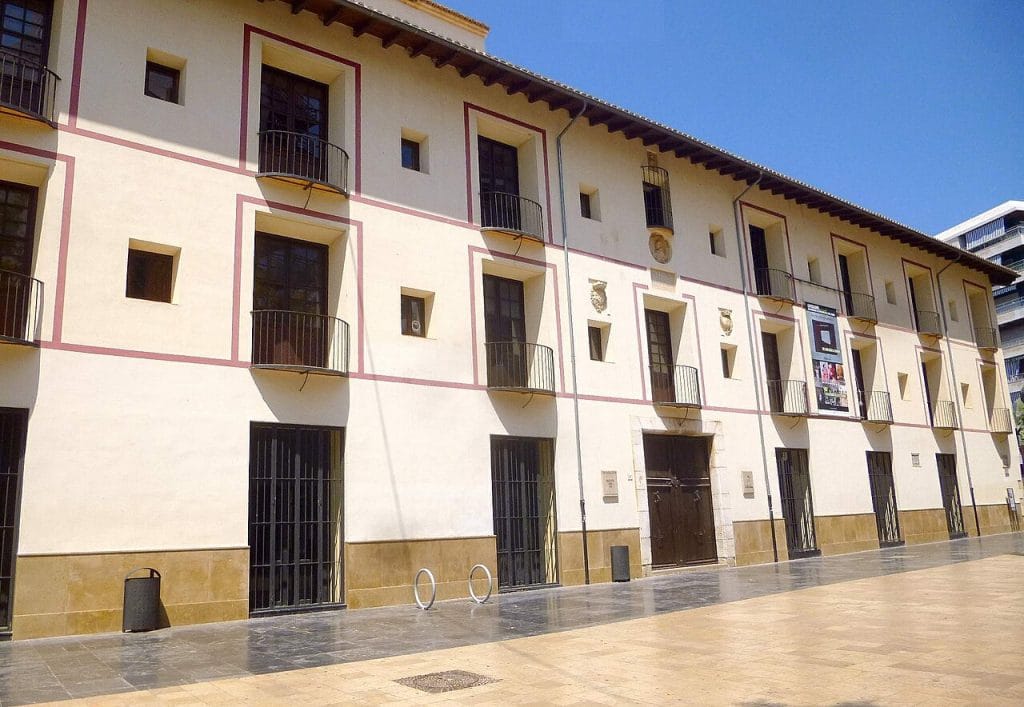
Few cities of their size can boast about having had their own university right in the middle of the Renaissance. Gandia did: founded by Francis Borgia, IV Duke of Gandia, the old university operated between 1547 and 1772, and its building, that of the Escoles Pies, continues to educate today in the heart of the Centre Històric.
Contents
If you stroll through the centre of Gandia, the facade of the Escuelas Pías might look like just another school. In reality, you are standing before one of the city’s most historic buildings: the first university of the Society of Jesus, classroom to Baltasar Gracián and, more than four centuries later, home to the UNED. Here is its story in four chapters.
A university born of the Borgias
The university was a personal project of Francis Borgia, the duke who would eventually become Superior General of the Jesuits and a saint. Its founding was no overnight affair, but rather a process that extended from 1546 to 1549: Pope Paul III issued the papal bull Copiosus in misericordia on 4 November 1547, authorising the granting of university degrees, and by 10 May 1548 the Jesuit community was already occupying the building, which was still under construction.
It was not a mass university like Salamanca or Valencia, but a unique college-university: the Jesuit college and university shared the building, teaching staff and resources. Grammar, philosophy and theology were taught —in time, degrees linked to medicine and canon law also appeared—, and its qualifications, more accessible and affordable than those of Valencia, attracted students from all across the Kingdom. The complex grew for over a century, featuring two courtyards, a kitchen garden, a library and a large church erected between the late XVI century and 1636.
Classrooms with illustrious names: from Baltasar Gracián to Cavanilles
The most famous professor to step foot in these classrooms was Baltasar Gracián. The author of El Criticón lived in Gandia between 1633 and 1636 as a professor of philosophy, grammar and moral theology, and it was here that he took his solemn vows in 1635. It is very likely that in the college library —one of the best equipped in the Jesuit province— he began writing El Héroe, his first major work.
He was not the only notable figure. Gandia also saw the likes of:
- Juan Andrés, Professor of Rhetoric in 1764 and later one of the great figures of the Hispanic Enlightenment.
- Mateo Aymerich, rector of the university and a reformer of the philosophical thought of his time.
- Antonio José Cavanilles, the great Valencian botanist, who obtained his doctorate in theology here in 1766.
From the expulsion of the Jesuits to the Escuelas Pías school
The end came in two blows. In the early hours between 3 and 4 April 1767, with the expulsion of the Jesuits from Spain, troops occupied the college and the community departed into exile. The university survived for a few years with lay teachers, until a Royal Decree of 11 August 1772 declared it defunct. After 225 years, Gandia ceased to be a university city.
The building, however, lived on. Following several renovations and failed projects, the town council agreed in 1804 to restore its educational role in the hands of the Piarists (escolapios), who took possession in 1807. Except for the darkest chapter in its history —during the Civil War and post-war period, when it was used as a prison between 1936 and 1942—, it has never stopped being a school ever since.
What you can see today
The complex, thoroughly restored in the 1990s and protected as a Property of Cultural Interest (Bien de Interés Cultural), stands next to the former entrance to the Centre Històric, in the Plaza de las Escuelas Pías. The best-preserved element from the Jesuit period is the church, with its dome and its nineteenth-century Communion chapel; the rest of the building is a fascinating palimpsest of renovations from the XVIII, XIX and XX centuries.
And most remarkably: almost 480 years after Francis Borgia’s project, the building remains dedicated to education. Today, it brings together the Escola Pia school, the UNED Gandia branch —established here since 1988— and adult education. Bear in mind that it is an active educational centre: it forms part of the visitable sites in the historic centre and on the Borgia route, but access to the interior is subject to guided tours and scheduled activities.
If you are staying in Gandia, pop by the square at dusk: it is one of the most historically rich stops along the entire Borgia route, just a stone’s throw from the Ducal Palace and the city’s commercial heart.