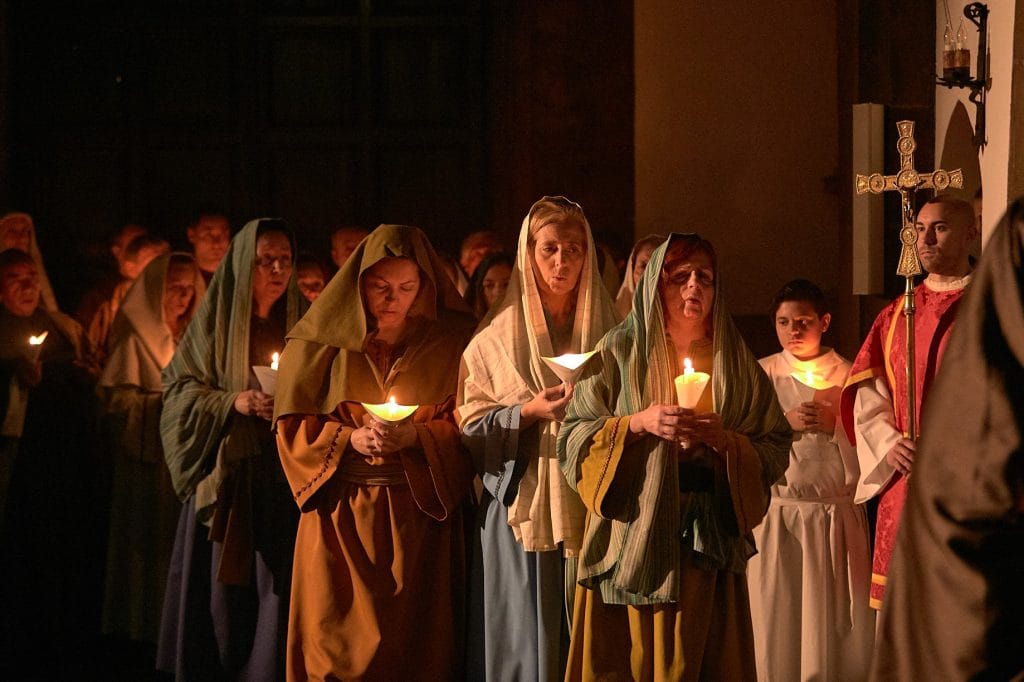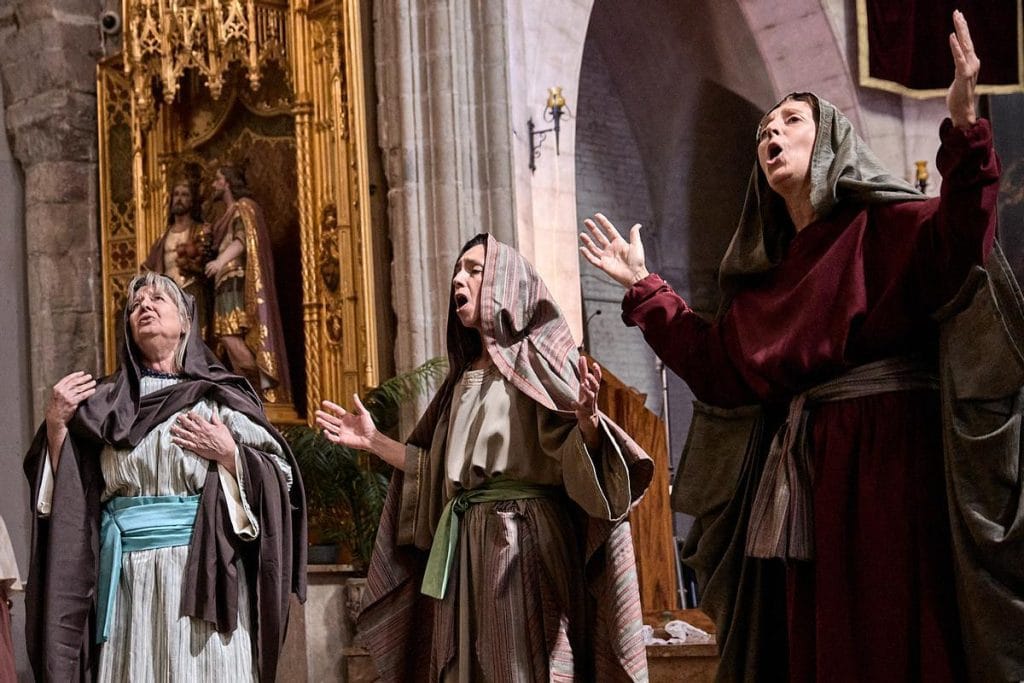
Every Holy Saturday, the Colegiata de Santa María de Gandia hosts the Visitatio Sepulchri, a sacred sung drama attributed by tradition to Saint Francis Borgia that was banned for 133 years before returning to the stage.
Gandia is known for its beach, but its historic centre holds an intangible treasure connecting the city with Renaissance Europe. The Visitatio Sepulchri is a lyric-liturgical performance of the Passion and Resurrection, considered a milestone of early European theatre and music. If you are looking for a cultural reason to visit the capital of La Safor, this is one of the most remarkable — and around it unfolds a whole route through the Borgia legacy that you can explore at any time of year.
A drama born in the Borgia court
Although there are indications of earlier processional dramatisations, the official establishment of the work was recorded on 4 August 1550: on that day, as recorded in the Libre I de Recorts, the chapter members of the Colegiata met with Francis Borgia, 4th Duke of Gandia and future Superior General of the Society of Jesus, and agreed to give solemn form to the performance. Authorship of the piece has historically been attributed to the holy duke himself, a nobleman with a broad humanistic education and remarkable musical talents.
The work even survived the restrictions placed by the Council of Trent on theatre inside churches, but in 1865 the Archbishopric of Valencia decreed its suspension, alleging that the original Papal Brief granted by Alexander VI — the Borgia Pope — could not be located, presumably lost in the 1781 fire at the monastery of Santa Clara. Thus began a 133-year silence, until in 1998 musicologist José María Vives Ramiro completed the textual, musical and stage reconstruction of the work based on surviving manuscript sources, including the 1550 act, a consueta copied in 1697 and an 1882 musical transcription.
From the silence of the burial to the seven-voice Alleluja
The performance was originally conceived across two parts, now unified into a single morning session, and its main appeal lies in the contrast between the two:
- The Holy Burial — a planctus or processional funeral lament through the streets of the Centre Històric, featuring monodic melodies with Gregorian roots and an almost complete atmosphere of solemnity.
- The Resurrection — at the doors and inside the Colegiata. It begins with the dialogue of the Quem quaeritis (“Whom seek ye in the sepulchre, Christian women?”) between the angel and the three Marys, and the monody then bursts into multi-voiced Renaissance polyphony — something exceptional in liturgical drama of the era — culminating in a seven-voice Alleluja.
The procession maintains its historical hierarchy: it is led by the priest or capiscol, followed by choirboys dressed as angels, children playing shawms, and the three choirboys embodying the three Marys. A chapel of minstrels, with exact replicas of ancient wind instruments, doubles the voices of the choir beneath the Gothic vaults — an acoustic setting that alone makes an early start worthwhile.
The score has also demonstrated remarkable vitality: in 2010, the American trumpeter and composer Michael Philip Mossman reinterpreted it in a jazz style alongside prominent Valencian musicians, on an album released on vinyl that transforms the Renaissance melodies into the language of hard bop.
When and how to see it
The Visitatio Sepulchri takes place every Holy Saturday at midday — at 12:30 in recent editions — at the Colegiata de Santa María, with free admission until full capacity is reached. Arriving early is recommended: it is one of the highlights of Gandia’s Holy Week, declared a Festival of National Tourist Interest in 2019, which involves eighteen brotherhoods over ten days of processions and concludes on Easter Sunday with the Encuentro Glorioso outside the Palau Ducal.