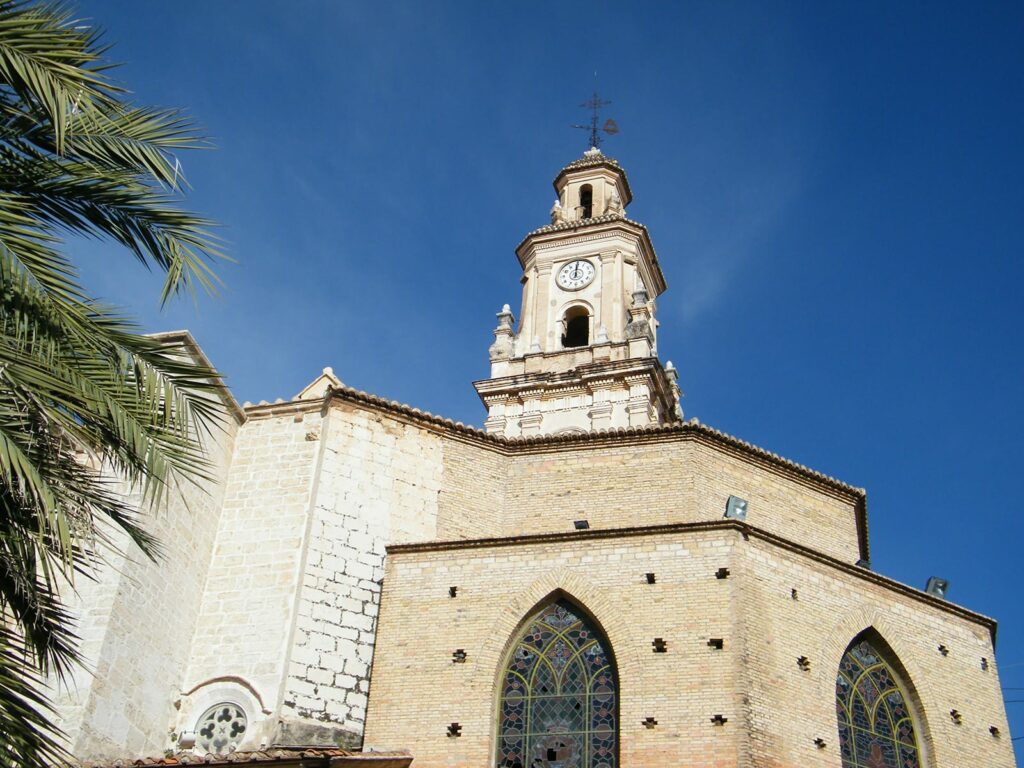
Among the buildings of Gandia’s cultural heritage, the Collegiate Church of Santa María is undoubtedly one of the must-see sites when visiting the city. Let us take a closer look at this jewel, declared a National Historic Monument in June 1931.
Contents
History of the Collegiate Church
Although it is said that a Visigothic church already stood here in the 8th century, the true origins of the collegiate church date back to 1245, when, following the capture of Bairén Castle by James I, construction began on the Parish Church of the Assumption of Our Lady.
First period: Alfonso of Aragon ‘El Vell’ and Alfonso ‘El Jove’
However, it was not until the end of the 14th century, under the lordship of Alfonso of Aragon, that Johan Franch and Bernat Oliver began constructing the Gothic-style temple. Upon his death, it was his son, Alfonso ‘El Jove’, who commissioned the architect Nicolau Esteve to continue with the remodelling works.
When Alfonso ‘El Jove’ died without issue in 1424, the lordship passed, after a succession dispute or two, into the hands of the Crown of Aragon.
Second period: The Borgia family and the influence of María Enríquez
In 1485, Rodrigo Borgia, who would later become Pope Alexander VI, purchased the Duchy of Gandia from King Ferdinand II of Aragon (Ferdinand the Catholic). Through a Papal Bull issued by Pope Sixtus IV, Pedro Luis Borgia, Rodrigo’s son, was legitimated as the first Duke of Gandia. When he died prematurely, his brother Juan Borgia became the second Duke of Gandia, marking the beginning of the Borgia family’s major influence in helping the Collegiate Church of Santa María in Gandia shine in all its splendour.
The second duke also died prematurely. And it was his widow María Enríquez de Luna, who took over the regency of the duchy until her son came of age, securing the papal bull from Pope Alexander VI that raised the Parish Church of the Assumption to collegiate status in the year 1500. It was she who commissioned the architect Pere Compte to remodel and complete the work as it can be admired today.
The façade
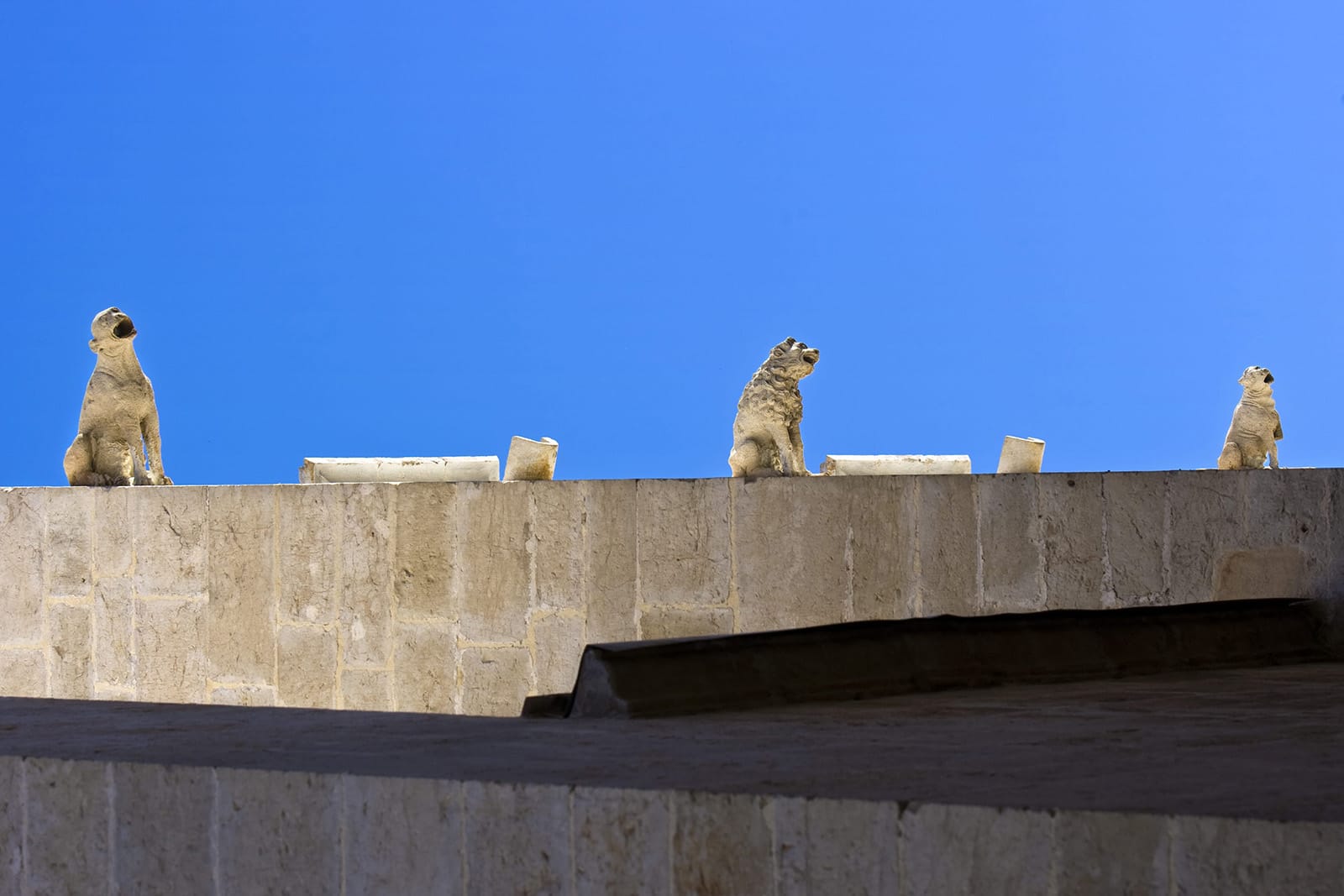
The building is in the Valencian Gothic style and its bell tower, created by the monk Onofre Trotonda, can be seen from almost anywhere in the city. The sanctuary, which was originally square, was demolished in 1936 and rebuilt in a Neo-Gothic polygonal shape. The façade is simple and unadorned apart from several gargoyles crafted by Pere Compte, which serve as water spouts.
The doorways
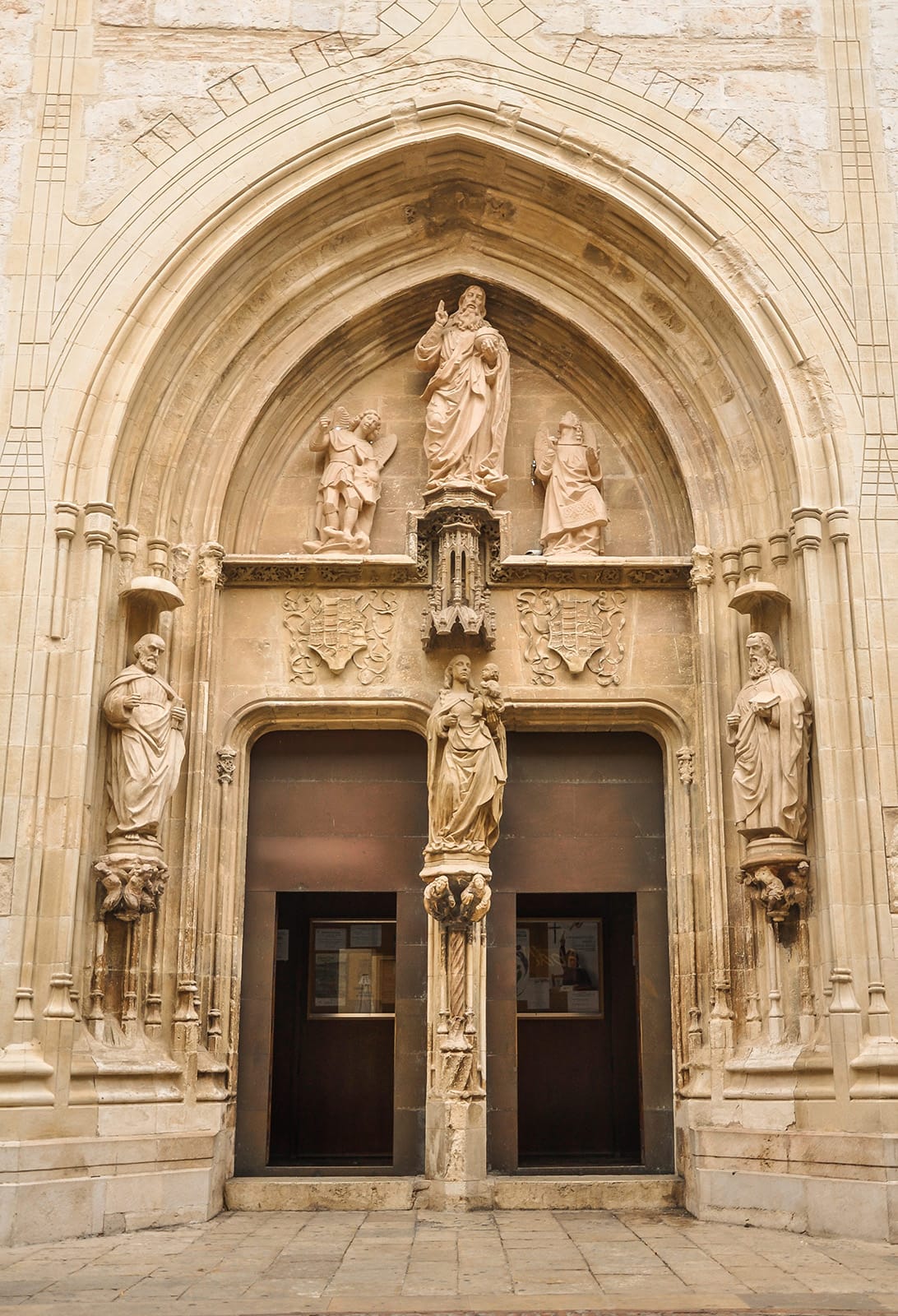
The Doorway of Santa María is located on the side of the church, is Gothic in style, and is dominated in the centre by an image of the Assumption seated above the devil. It is framed by several columns, some with smooth mouldings and others adorned with figures of angels.
The Doorway of the Apostles is on the western façade; it was created by Damián Forment and dates from the late Gothic period, although the early influences of the Renaissance are already visible in the sculptures. The centre is presided over by the figure of the Creator, flanked by Saint Michael and Saint Gabriel. Above the doorway is a 4-metre-diameter rose window in the Flamboyant Gothic style, which illuminates the interior.
The church
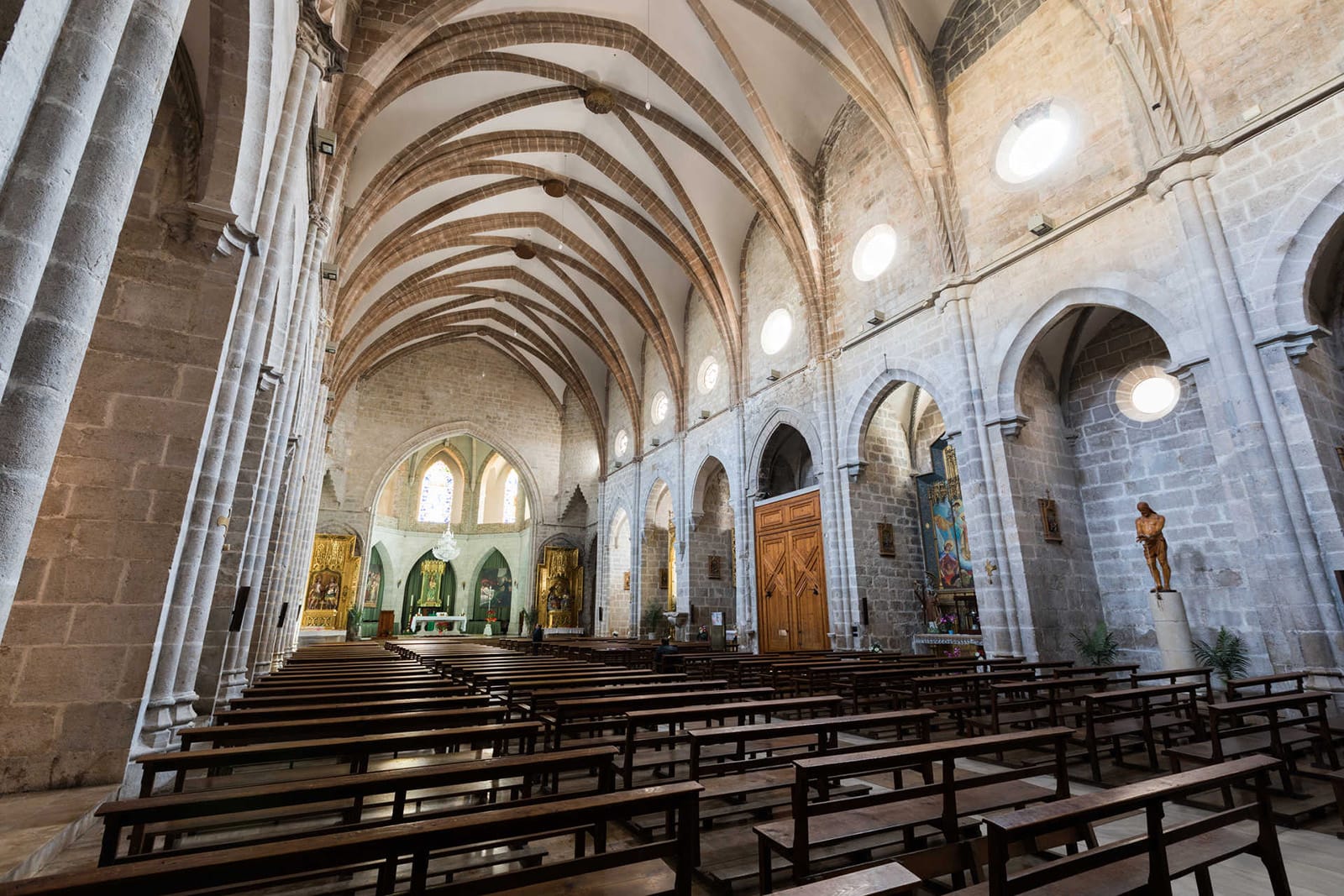
Upon entering the church, you will see that its interior consists of a single nave, simple and open. Looking up, you can admire the ribbed vaulting of each of the nine bays that make up the nave. The junction point of each bay is marked by a keystone. The central keystone was carved by Joan Franch, painted by Bernat de Vilaür, and depicts the Resurrection.
Along both sides of the nave, set within each bay, are the chapels. Notable among them are the chapel of Saint Francis Borgia, patron saint of the city, the altar chapel of Saint Anthony of Padua, and the Chapel of the Sacred Heart of Jesus (Communion Chapel).
In each bay of the Collegiate Church there are two ocula, one on each side. Those in the first bays are the work of Joan Franch in the monastic Gothic style, while those in the bays dating from the era of the Duchess Regent were crafted by Pere Compte.
The presbytery was originally decorated with an altarpiece carved in alabaster by Damián Forment, completed by several panel paintings by Paolo da San Leocadio depicting the Seven Joys of the Virgin Mary. There was also a wooden carving of Saint Mary with Child and a Calvary. This altarpiece perished in the fire of 1936, and today it is presided over by a copy of the Mare de Déu de la Seu, created by Esteve Edo and Ricardo Rico, alongside a copy of a mid-15th-century Gothic Processional Cross.
Visiting the Collegiate Church
Within Gandia’s historical and cultural heritage, the Collegiate Church of Santa María is one of the city’s most important and iconic landmarks, making it a must-visit when travelling through Gandia. Located in the main square, right next to the town hall and just a 5-minute walk from Hotel Borgia, it is a site steeped in history and part of a grand cultural legacy that should not be missed.
You can check additional information such as visiting hours, mass times, and other celebrations on their website colegiatagandia.org.
Location of the Collegiate Church of Santa María in Gandia (map)
Photos of the Collegiate Church