Every year, between late May and June, Gandia celebrates Corpus Christi, a festival that the city has kept alive since 1391: centuries-old dances, giant tapers and streets carpeted with myrtle in the heart of the Centre Històric.
Contents
Gandia’s Corpus Christi is one of the oldest celebrations in the Valencian Community and, probably, the one that best captures the character of the city: in the morning, the solemnity of the Pontifical Mass in the Colegiata; in the afternoon, a street festival where giants, big-heads and Baroque dances coexist with the Eucharistic procession. If your visit coincides with it, it is well worth organising your day around the Plaça Major.
More than six centuries of festivities in the city of the Borjas
Gandia has celebrated Corpus Christi continuously since the end of the 14th century, and the arrival of the Borja family in the duchy served only to grandly enhance the festival’s public staging. It is no coincidence that its epicentre is the Insigne Colegiata de Gandia, the church where Saint Francis Borja was baptised, nor that the religious organisation falls to the Archpriestship of the Holy Duke, which brings together all the city’s parishes. The civic side, with its street dances, is coordinated by the Associació Cultural Balls del Corpus de Gandia, the legacy of extensive folklore recovery efforts that brought dances back to the streets that had disappeared in the 19th century.
The dances: the Moma, the Magrana and a whole festive bestiary
On Sunday afternoon, the Plaça Major becomes the stage for the Danses del Corpus, which are then repeated at several stops along the procession route. Here are the stars of the show:
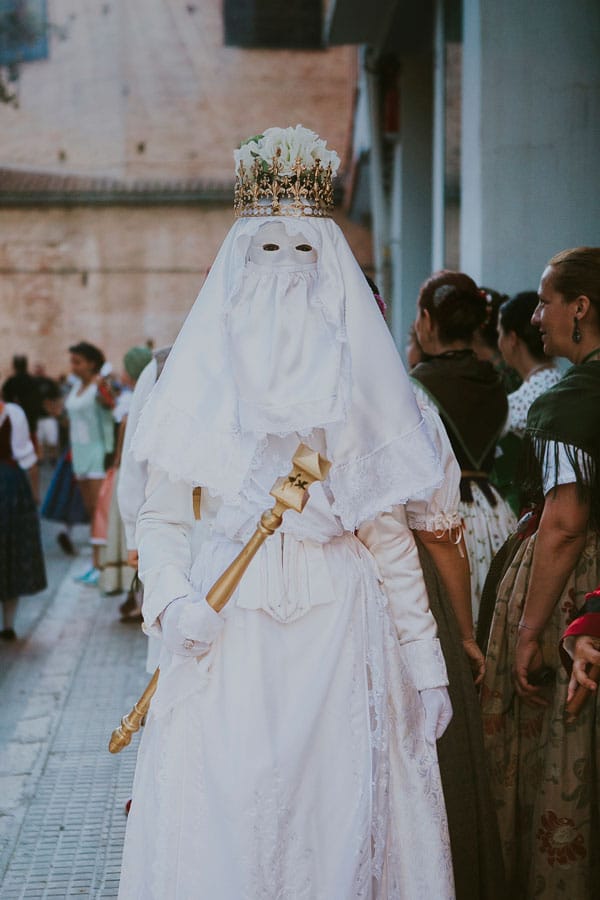
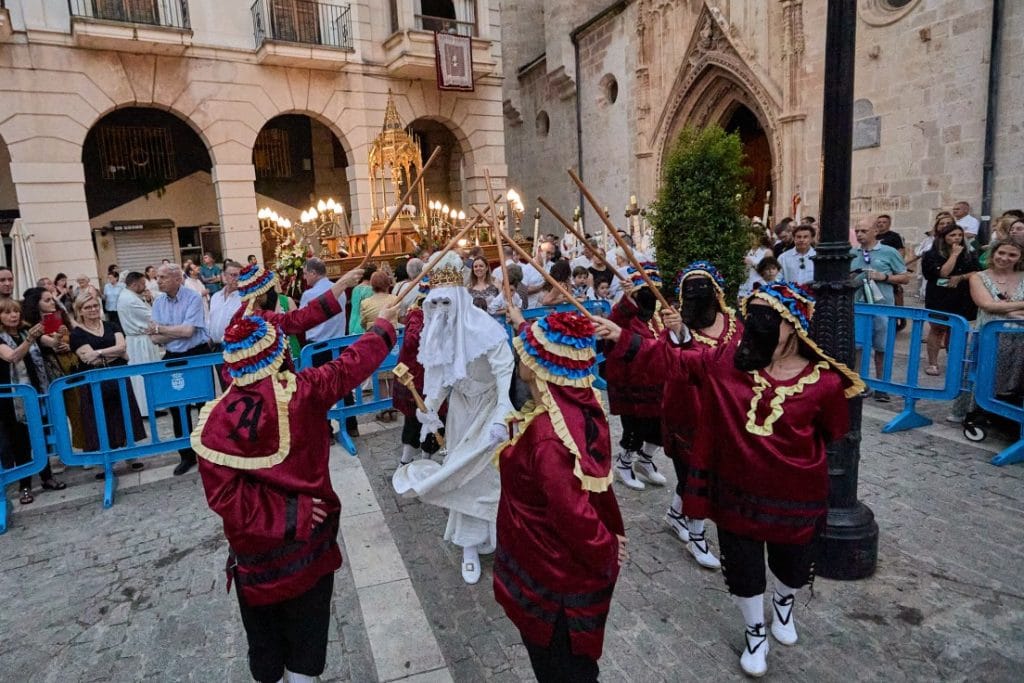
- El Ball de la Moma — the jewel of the festival, documented in 1678. The Moma, dressed in white with a veil and floral crown, embodies Virtue; around her, seven Momos wearing black masks represent the capital sins, who end up surrendering before her.
- La Dansà de la Magrana — a dance of coloured ribbons woven around a pole topped with a wooden pomegranate that, at the end, opens into segments to reveal a small monstrance inside.
- El Ball de Cavallets — documented in 1615, eight children ride papier-mâché hobby horses, evoking the retinue of the Three Wise Men.
- Els Gegants de Gandia — pairs of giants representing the three cultures, parading to the sound of the tabal i dolçaina.
- El Ball de Cabets — big-heads with grotesque and satirical expressions, providing a mocking counterpoint to the procession.
- Ball de Bastons, Ball d’Arquets, Dansà dels Llauradors and Vetes de Sueca — warrior-style stick dances, flower arches, offerings from the fertile lands and silk ribbons complete the ensemble.
The procession: els Cirialots and the aroma of myrtle
As dusk falls, the most solemn moment arrives. Ahead of the Monstrance march els Cirialots: 26 men dressed as the elders of the Apocalypse, with long white beards and wigs, carrying tapers measuring around 2.65 metres and weighing nearly 15 kilos each. The Monstrance is escorted by the Hermandad de la Santa Cena del barrio de Santa Anna, and the entire procession passes over the carpet of myrtle covering the streets of the historic centre: as it is stepped on, the myrtle releases a scent that permeates the entire route. It is one of those sensory details you will never forget.
Corpus sweets: la Delicà and other classics from La Safor
The festival is also experienced through food. The ultimate sweet treat is la Delicà de Gandia, made by authorised bakeries in the city on a panquemado base with egg yolk, almond, candied orange, raisins and walnuts. Its name comes from a local legend: that of a young woman so delicate she died when a jasmine petal fell on her — although the historical version speaks of a stone fragment detached from the rose window of the Colegiata. Completing the table are pumpkin or sweet potato arnadí, a legacy of Andalusian pastry-making, the Corona de Gloria, the Casca de Reis and the crunchy reganyà.
Key tips for experiencing it
- When — it is a moveable feast linked to the Easter calendar: it falls between late May and June, and the main events take place on Sunday. Each year’s programme is published by the Ajuntament de Gandia.
- Where — Plaça Major, Colegiata and streets of the Centre Històric, with choreographic stops along the procession route.
- How much it costs — nothing: dances, procession and cultural events are free to attend.
- A top tip — arrive at the Plaça Major with plenty of time to watch the afternoon dances; it is the busiest moment and the best spot to see them up close.
The Valencian Corpus Christi also aims to be declared Intangible Cultural Heritage of Humanity by UNESCO, a candidacy that recognises the work of cities like Gandia to keep their dances, dolçaina music and procession alive. If you are looking for a date to discover the Centre Històric in its most authentic form, this is a sure bet.