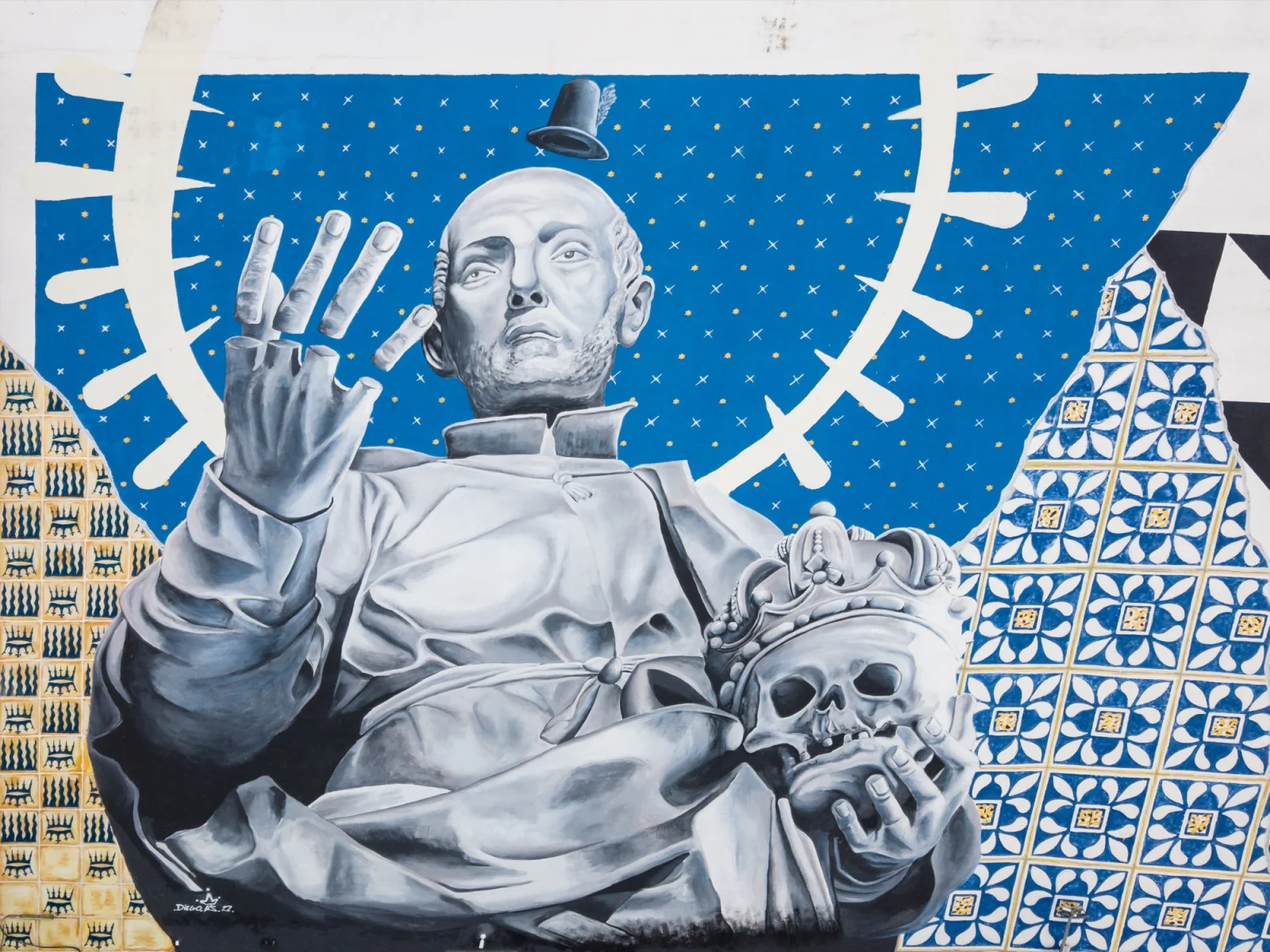
Since 2022, the façade of Hotel Borgia has been home to a monumental mural of Saint Francis Borgia, patron saint of Gandia, painted by muralist Diego As. Here is how it was created and what its imagery means.
Contents
Anyone strolling along avinguda República Argentina comes face to face with him: a Saint Francis Borgia several storeys tall, blessing the street from the side wall of the hotel. Many of our guests ask about its story, so we have gathered it here, together with photographs of the process and the video of how it was painted.
The patron saint of Gandia, on a monumental scale
The mural depicts Saint Francis Borgia, 4th Duke of Gandia and patron saint of the city. If you would like to get to know him properly, our blog looks at who Saint Francis Borgia was.
Diego As paints him in greys, like a living sculpture, against a blue sky scattered with stars. The saint holds a crowned skull, the attribute he has been portrayed with for centuries: after seeing the corpse of Empress Isabella of Portugal in Granada, whose beauty had been celebrated during her lifetime, Francis Borgia changed the course of his life, a path that would lead him to the Society of Jesus and to sainthood. The press covering its unveiling described it as a mural of grand dimensions, around 24 by 40 metres; the artist himself presents it on his website as an XXL wall. The work also arrived in the year Gandia was commemorating the 450th anniversary of the saint’s death.
Diego As, the artist
The commission bears the signature of Diego As, a muralist from Lugo with an international reputation: his Julio César, painted in Lugo, was named best mural in the world of 2021 by the specialist platform Street Art Cities. On his website you can see the San Francisco de Borja project page alongside the rest of his work. The Gandia mural formed part of the city’s drive to promote the Borgia legacy, and it found the perfect canvas on the wall of our hotel.
How it was painted: from blank wall to the final detail
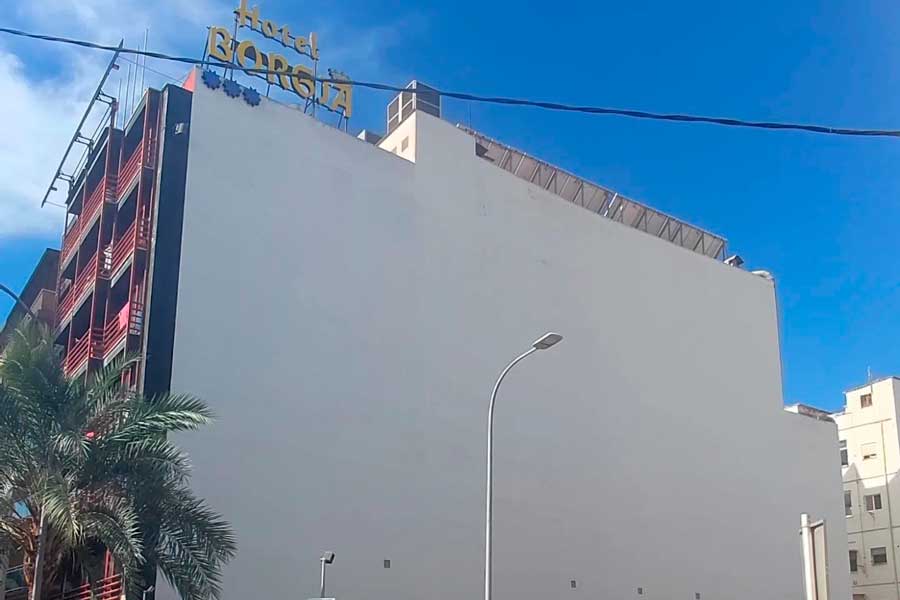
It all began with a bare wall. The hotel’s large windowless side, smooth and freshly prepared, offered a surface rarely found in the centre of Gandia: a clean plane dozens of metres across, visible from the street and from half the city.
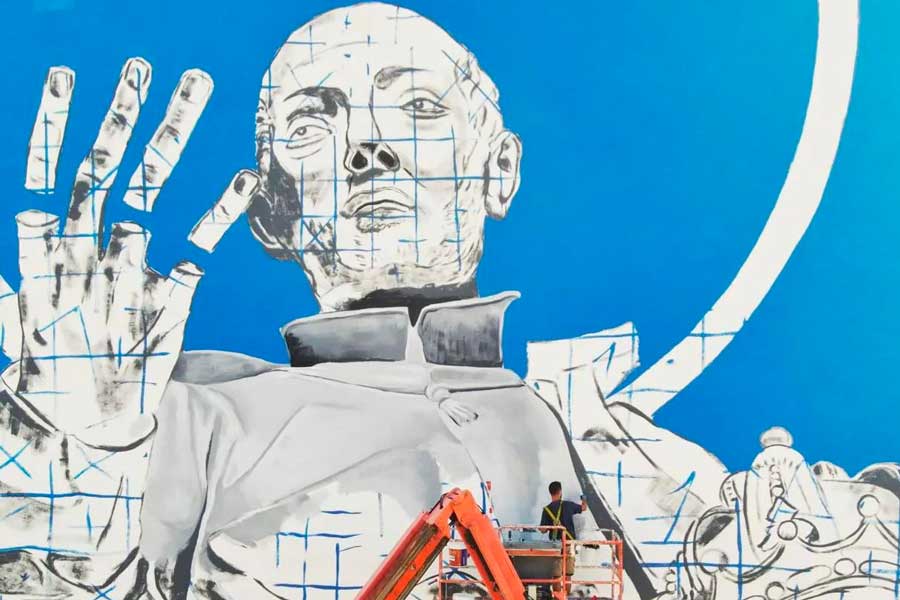
Over the base coat, Diego As mapped out the figure with a grid of blue lines, the classic method for scaling a sketch up to giant format without losing the proportions. From a lifting platform, armed with façade paint and spray cans, he gradually gave volume to the face, the hands and the folds of the habit.
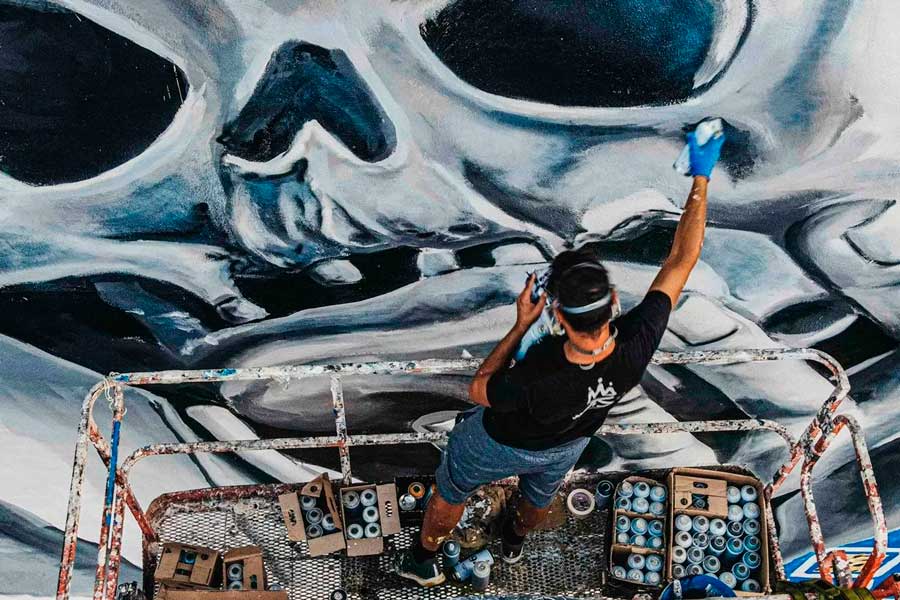
The working days stretched late into the night. One of the most striking images of the process shows the artist suspended in front of the skull, still in chiaroscuro, surrounded by boxes of spray cans on the crane basket. All of his patience shows today in the shading of the face and the highlights of the crown, which look as though they were carved in stone.
While the work went on, the mural’s progress became a small neighbourhood spectacle: locals and hotel guests followed from the pavement as the figure emerged from the wall, first as a ghostly outline and then in full volume.
The ceramics of the Palau Ducal, the great reference
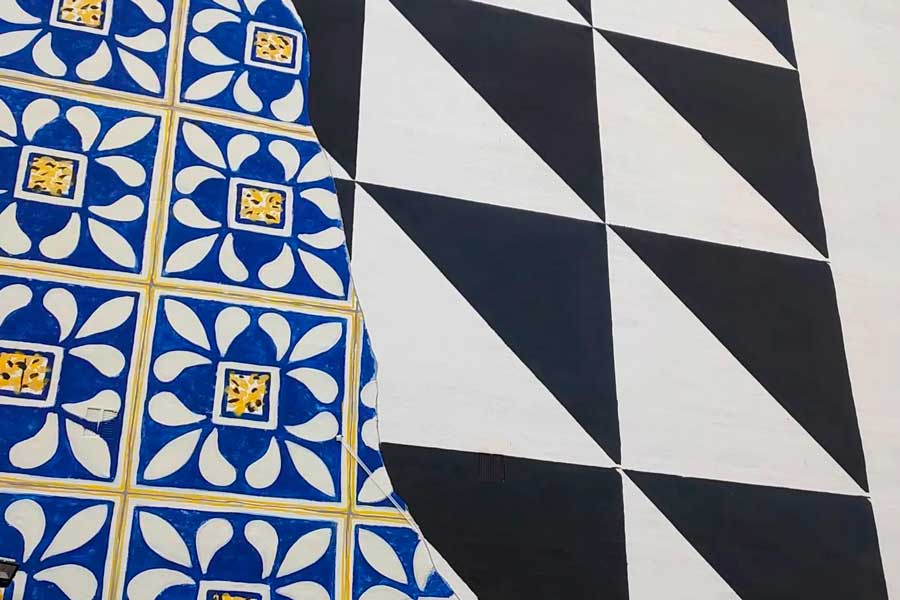
The artist himself explains that the mural’s references came from the Ducal Palace of the Borgias, the saint’s birthplace, with its ceramics and its history. The panels framing the figure reproduce traditional tilework in blues and golds alongside black-and-white geometric motifs, painted by hand tile by tile, like a tapestry that wraps around the saint and ties him to the city’s memory. The starry sky in the background is inspired by the ceiling of the chapel dedicated to Saint Francis Borgia inside the palace itself.
For the central figure, Diego As started from a sculpture of the saint kept at the Mafra National Palace in Portugal, which he came across while researching the character. From the statue he took the serene expression and the crowned skull; the rest came from his imagination.
Where to see it (and how to follow the Borgia trail)
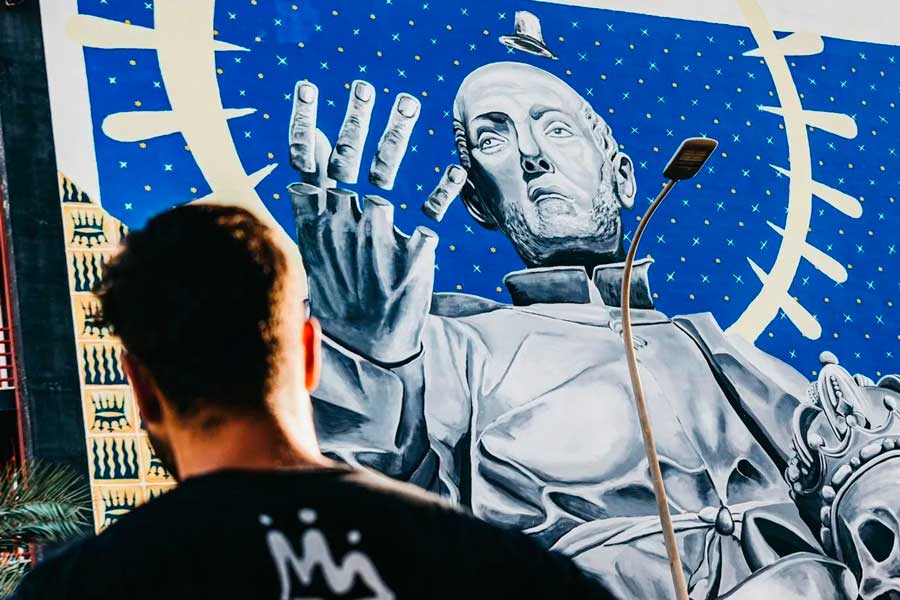
The mural is on the façade of Hotel Borgia, at avinguda República Argentina, 5 in Gandia, and can be admired free of charge at any time from the street. If it leaves you wanting more, it makes an excellent starting point for the «Territorio Borgia» urban route, which links the landmarks of the city’s most universal family.
The process, on video
To finish, there is nothing better than seeing it in motion: this is how the mural took shape, from the blank wall to the final highlight on the crown.