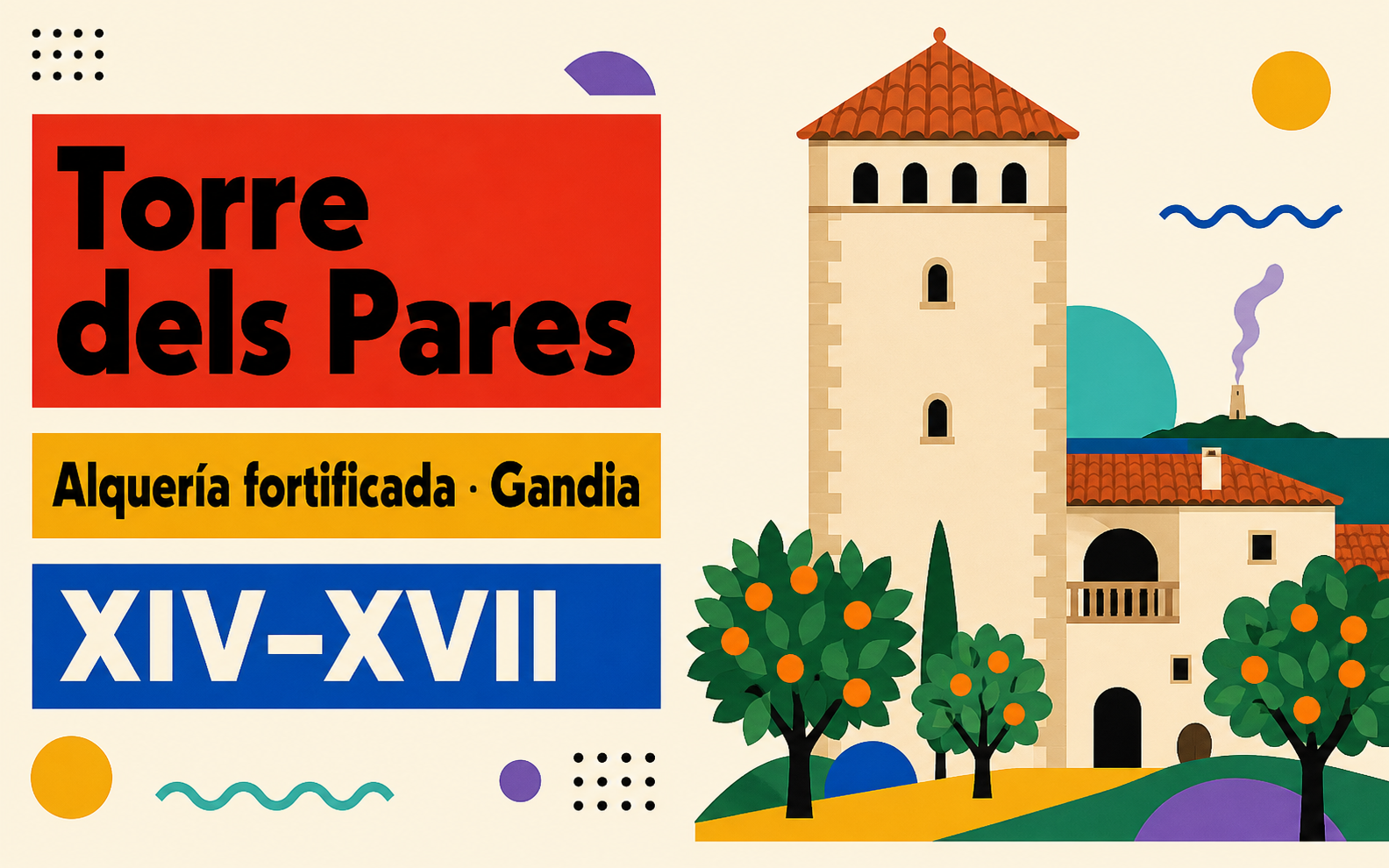
In the middle of the orange groves, a stone’s throw from the town centre, the Torre dels Pares lifts its five storeys above the fields that for centuries supported the old University of Gandia. It is one of the most unusual and least-known heritage visits in the city.
Contents
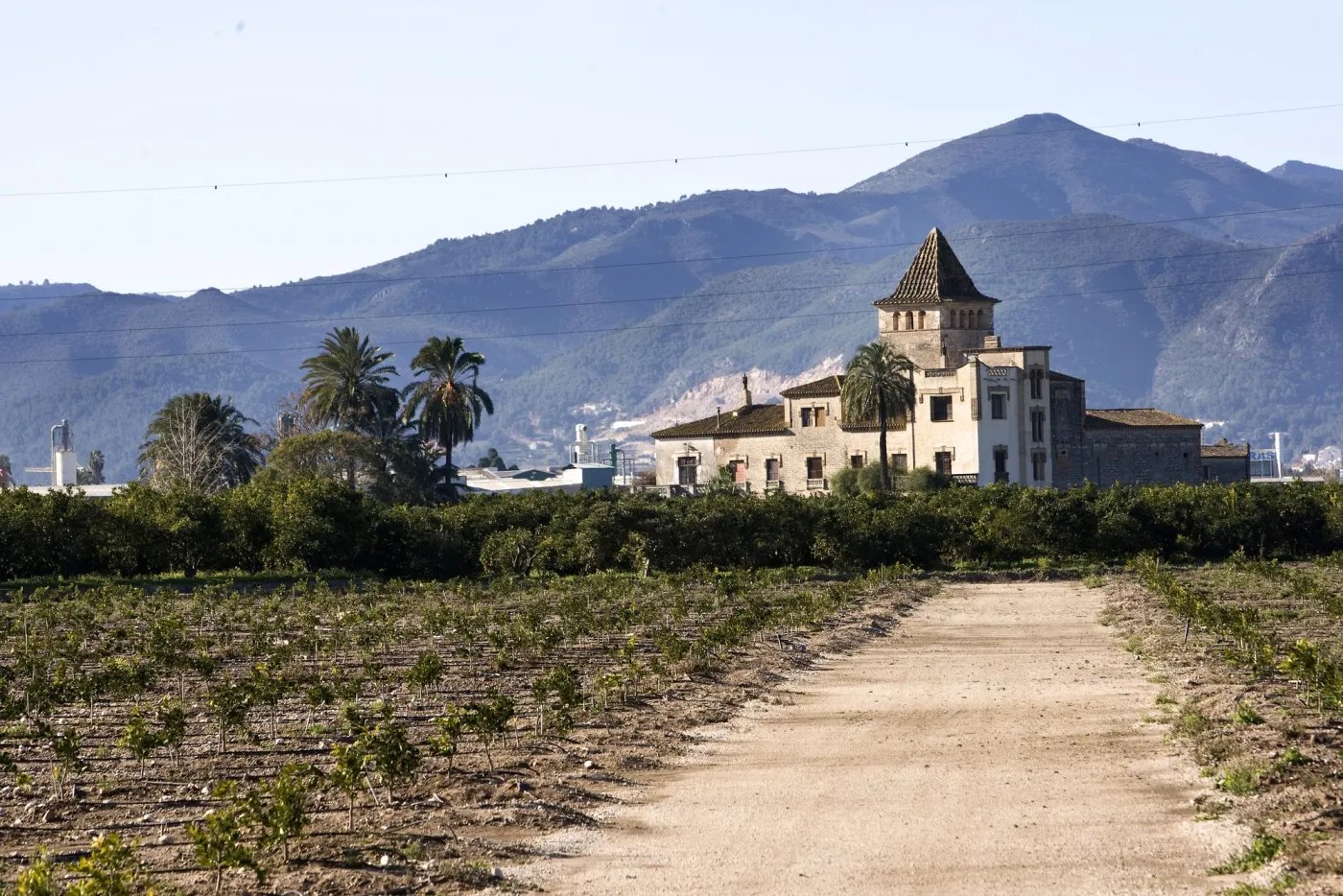
The fortified farmhouse of the Torre dels Pares stands beside the road linking Gandia and Daimús, very close to the La Vital shopping centre. Listed as a Bien de Interés Cultural (Spain’s highest heritage protection), owned by the city council and recovered after a full restoration, it now opens its doors for guided tours. Its history condenses five centuries of life in the huerta: the Borgias, the Jesuits, silk and oranges.
From the Balaguers to the Borgias: the origins of the estate
The estate enters the grand narrative of history with a sale: between 1485 and 1486, Pere Lluís de Borja, first Duke of Gandia from the celebrated Valencian family, bought the land from the brothers Jaume, Francesc and Miquel Balaguer. The purchase strengthened the duchy’s control over the most fertile farmland south of the city.
Decades later, Saint Francis Borgia, fourth Duke of Gandia and later Superior General of the Society of Jesus, handed the property to the Jesuits with a very specific commission: its farm income was to support the city’s Colegio-Universidad, the old University of Gandia, the first the order opened anywhere in the world. The religious community that ran the land ended up naming the place: the tower of the “Fathers”, Torre dels Pares. In the Society’s archives it also appears as Torre dels Colegians and Torre de San Ignacio.
A seventeenth-century tower: what archaeology has clarified
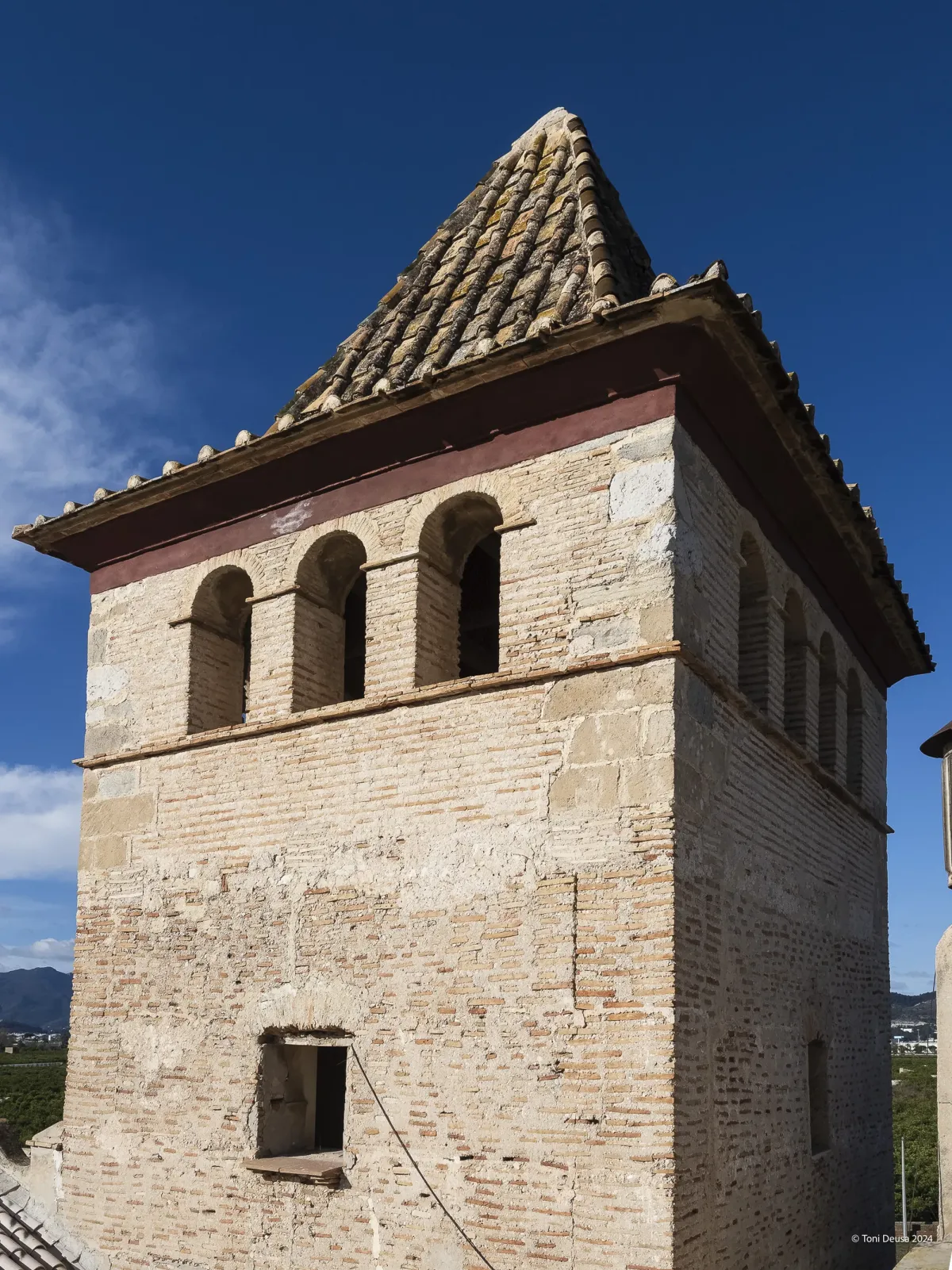
For a long time the tower was credited with medieval origins, Andalusi roots and a supposed fourteenth-century watchtower phase. The most recent archaeological research, published in 2024 after a study of its masonry, points in a different direction: the Jesuits built the tower from scratch from 1605 onwards, while laying out the farm buildings around it.
The reason for so much stone was very down to earth: Barbary piracy battered the Valencian coast, and a prosperous estate two kilometres from the sea needed to protect its harvests, livestock and workers. La Safor was then organised as a watchful landscape, with the Castell de Bairén overlooking the plain, watchtowers along the shore and fortified farmhouses such as the Alqueria del Duc dotted across the marshland. When enemy sails were sighted, warnings travelled along the coastal network as columns of smoke by day and bonfires by night, and country people took shelter behind the walls.
What to see: the tower, the courtyard and the traces of farming
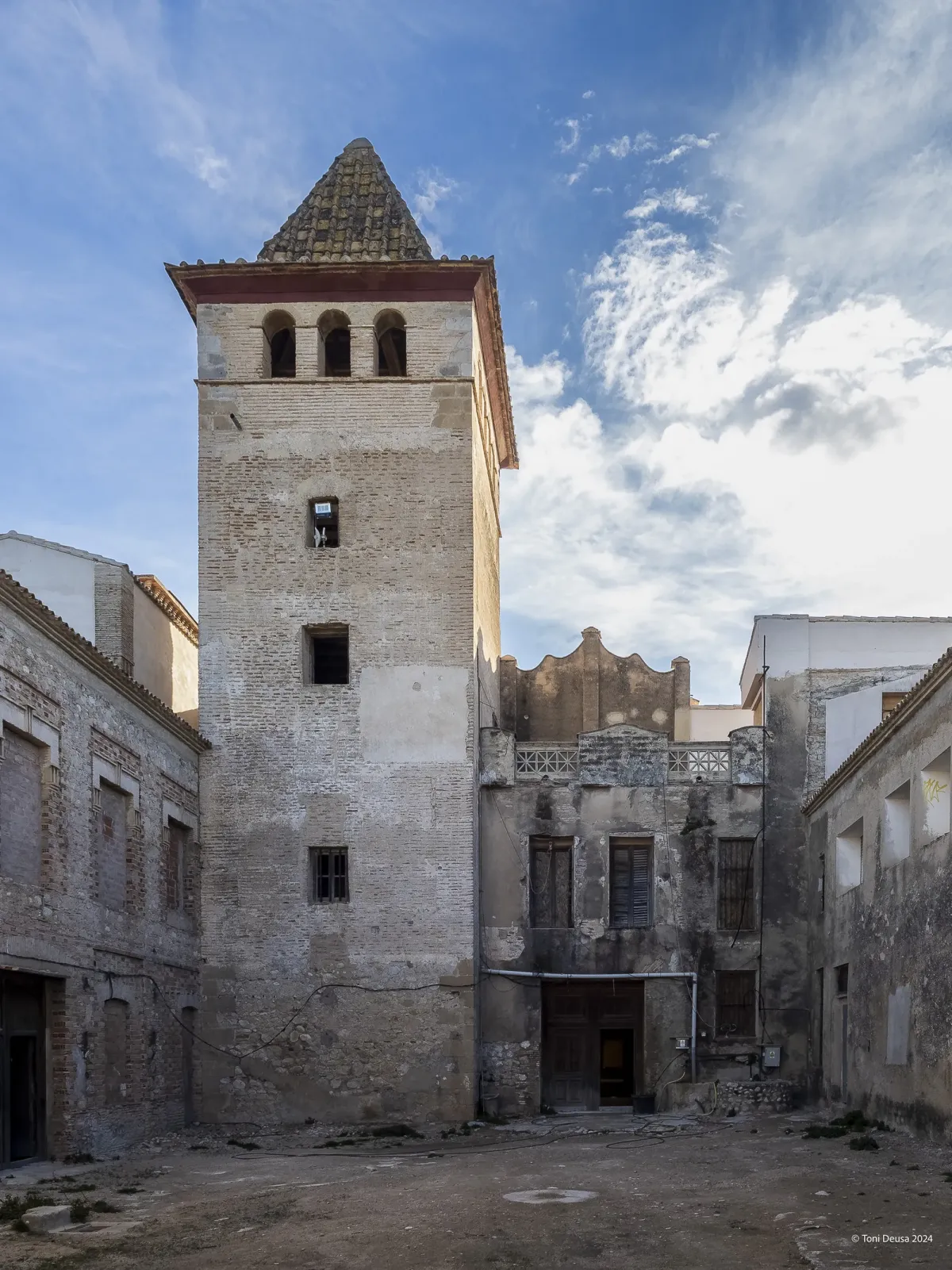
The tower commands the ensemble: a rectangular plan of 5.50 × 6.75 metres, five storeys and a hipped roof of flat tiles. The walls, of rubble masonry bound with lime mortar and reinforced with ashlar quoins, keep arrow slits and openings designed for defence.
At its feet, the farmhouse follows the classic Valencian layout: a central courtyard surrounded by the living quarters and the working buildings. The estate’s successive economies left visible marks on the buildings: the vines, olives and mulberry trees of the eighteenth century — with silk as the star crop — gave way to the citrus conversion of the nineteenth and twentieth centuries, which added warehouses and new living space.
From neglect to rescue: heritage listing and restoration
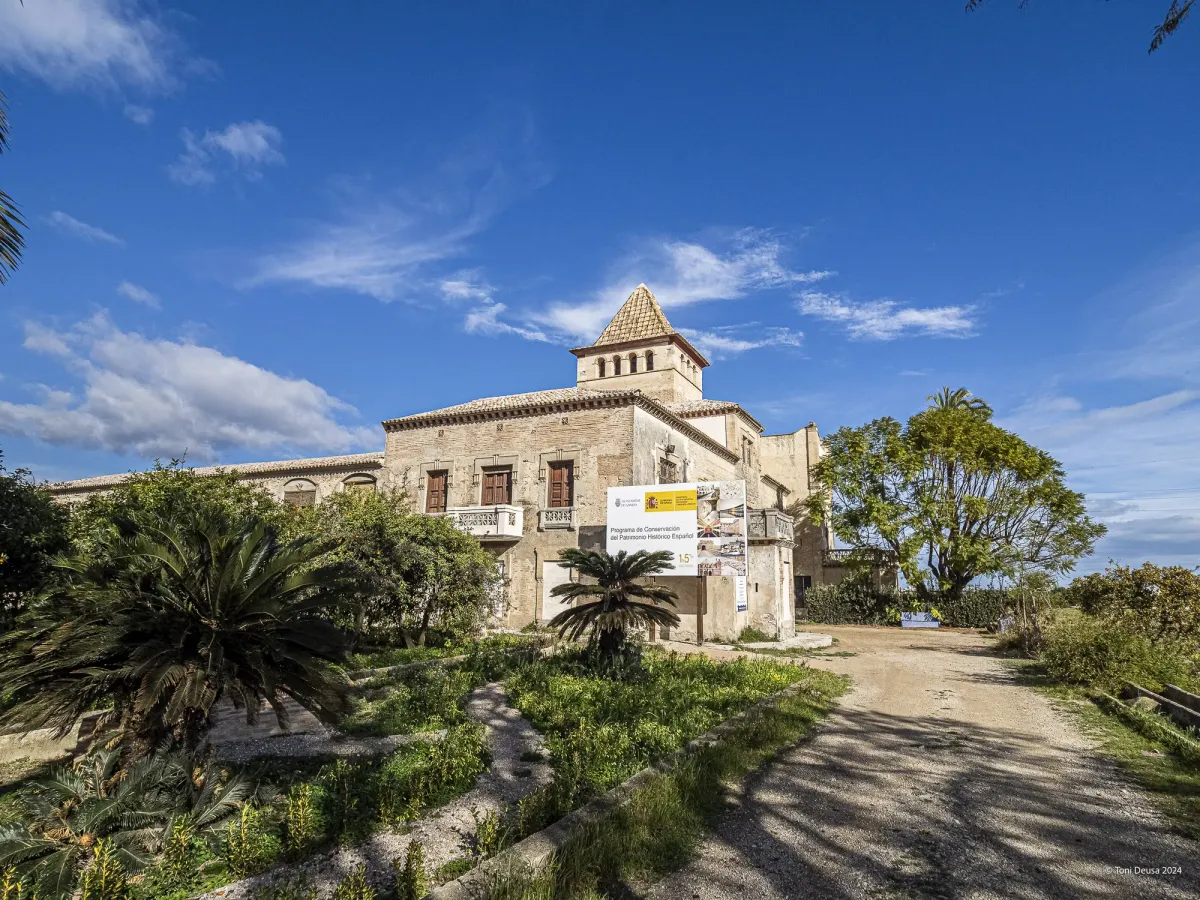
After the expulsion of the Society of Jesus decreed by Charles III in 1767, the estate was seized by the Crown and auctioned, and spent more than two centuries in private hands. The final third of the twentieth century brought the gradual abandonment of the complex.
Recovery came in stages: listing as a Bien de Interés Cultural on 7 July 2010, purchase by Gandia’s city council and a structural rehabilitation carried out between 2020 and 2023 with an investment of €822,000, funded 75 % by the 1.5 % Cultural programme of Spain’s Ministry of Transport and 25 % by the council itself. The works consolidated floors and roofs and included archaeological digs that now make the building’s biography easier to read.
Practical visit: when to enter and how to get there
The tower can only be seen on a guided tour, part of the heritage outreach programme coordinated by the Museu Arqueològic de Gandia (MAGa). Days and times change through the year, between the ordinary season and special campaigns such as the Estiu Arqueològic, so check the current calendar on the official XEC Gandia page or ask the museum directly on +34 96 295 95 40 or at difusiomaga@gandia.org. Tickets are inexpensive — €2 general and €1 reduced at the time of writing — and places are limited, so booking is recommended.
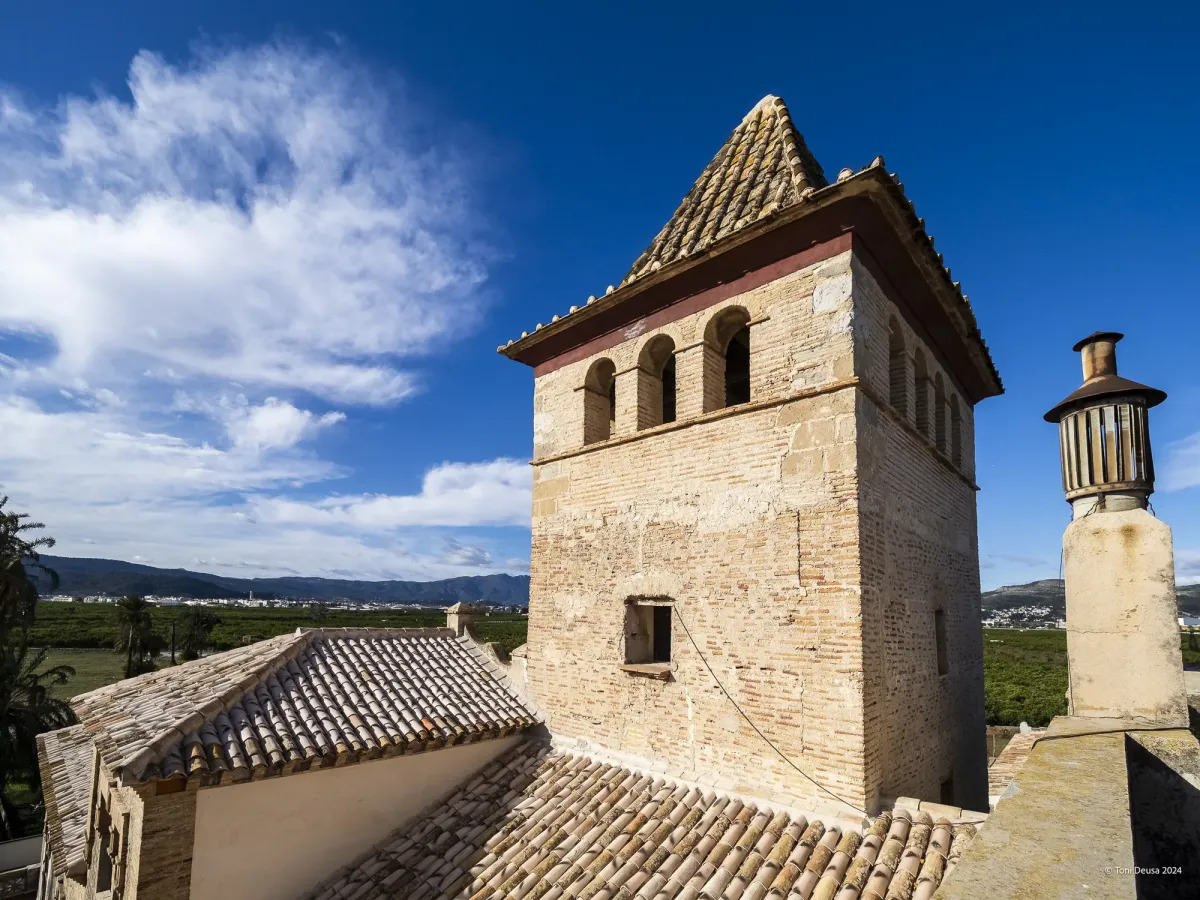
Getting there is easy: the farmhouse stands on the Camí Torre dels Pares, beside the road from Gandia to Daimús, about two kilometres from the centre, with a surfaced access road from the roundabout by the La Vital shopping centre (see the location). It can also be reached on foot or by bicycle along the Anella Verda, the green ring of paths that links the huerta with landmarks such as the Morabit de Marxuquera, the marshland and the Centre Històric. Comfortable footwear, water and sun protection complete the kit: the surroundings are still working farmland.
Few places sum up Gandia’s farming history so well: the tower paid for a university’s teaching, watched the coast for corsairs and stored orange harvests. The visit fills a morning and combines easily with a stroll through the Centre Històric or with the beach.