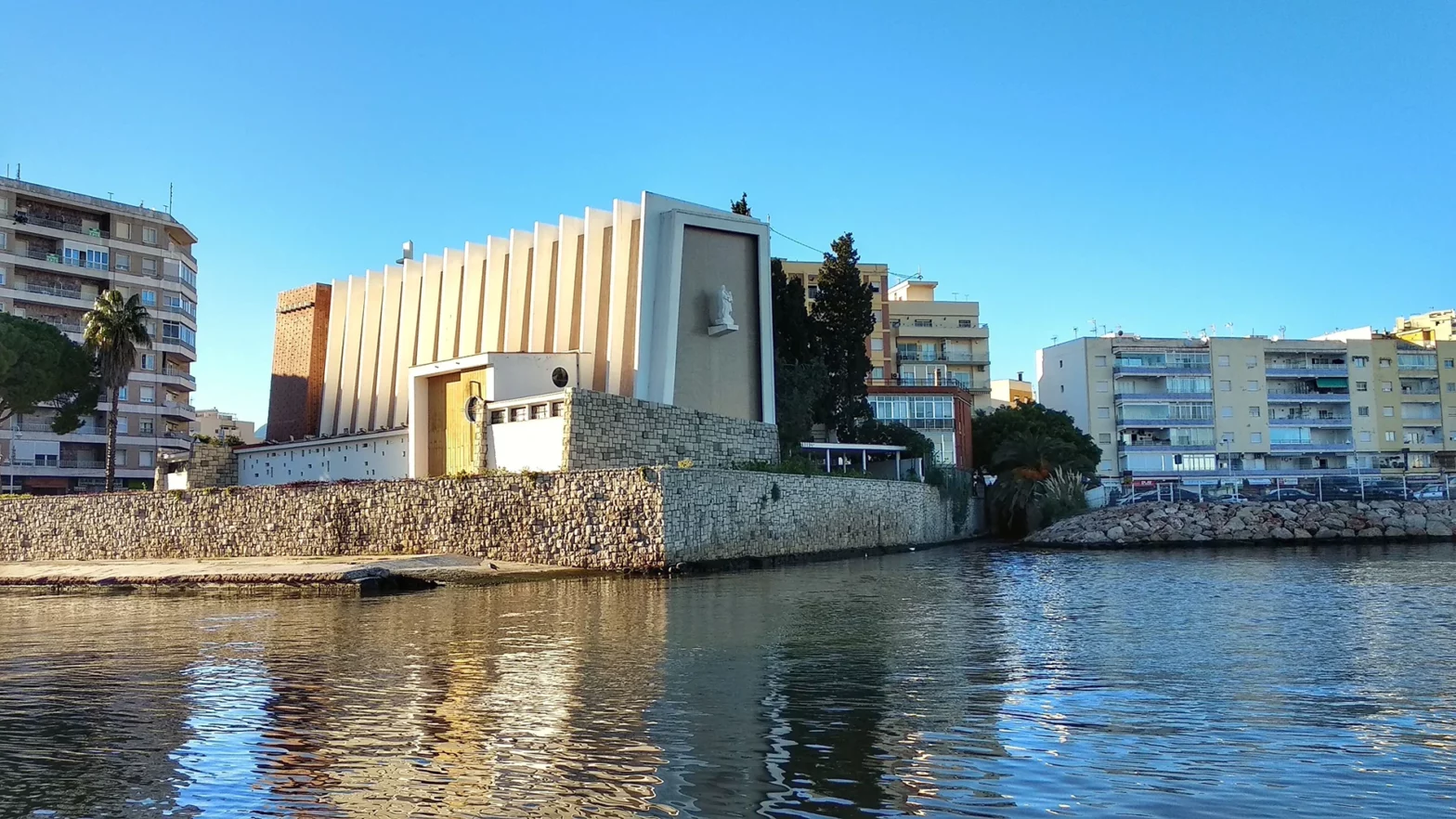
Facing the Grau harbour basin, the Church of St Nicholas of Bari seems to move towards the port like a ship. Inaugurated in 1962, it is one of the most distinctive religious buildings of modern Valencian architecture and one of the last major structures conceived by Eduardo Torroja.
Contents
Its appeal goes well beyond its exterior silhouette. The trapezoidal plan, folded concrete roofs, light running through the nave and direct relationship with the seafaring district make this church a different kind of visit in Gandia.
From the old hermitage to the church inaugurated in 1962
Devotion to St Nicholas in the Grau long predates the present building. A hermitage dedicated to the saint beside the river and the old mill was documented as early as 1373. The nineteenth-century church that replaced it was badly damaged during the Spanish Civil War and demolished in 1953. In the following years, the community held services temporarily in a port building used as a fish market.
The district’s growth and the activity of the port created the need for a larger building. The preliminary design was commissioned in 1958, and the project took shape the following year. Work began in the late fifties, and the new complex of church, cloister and presbytery opened for worship in 1962, although some finishing work and technical documentation continued afterwards.
Gonzalo Echegaray and Eduardo Torroja’s engineering
The project brought architect Gonzalo Echegaray Comba together with civil engineers Eduardo Torroja Miret and Jaime Nadal Aixalà. Torroja’s involvement accounts for much of the church’s structural boldness: it was one of his last works before his death in June 1961. His son, engineer José Antonio Torroja, continued the technical direction until the building was completed.
The church speaks the language of the Modern Movement while remaining closely connected to its setting. Seen from the port, its volume recalls the bow of a ship. This is more than a poetic comparison: its orientation, the profile of its roofs and the complex’s freestanding position reinforce its place in the history of the Grau of Gandia.
A concrete roof without intermediate columns
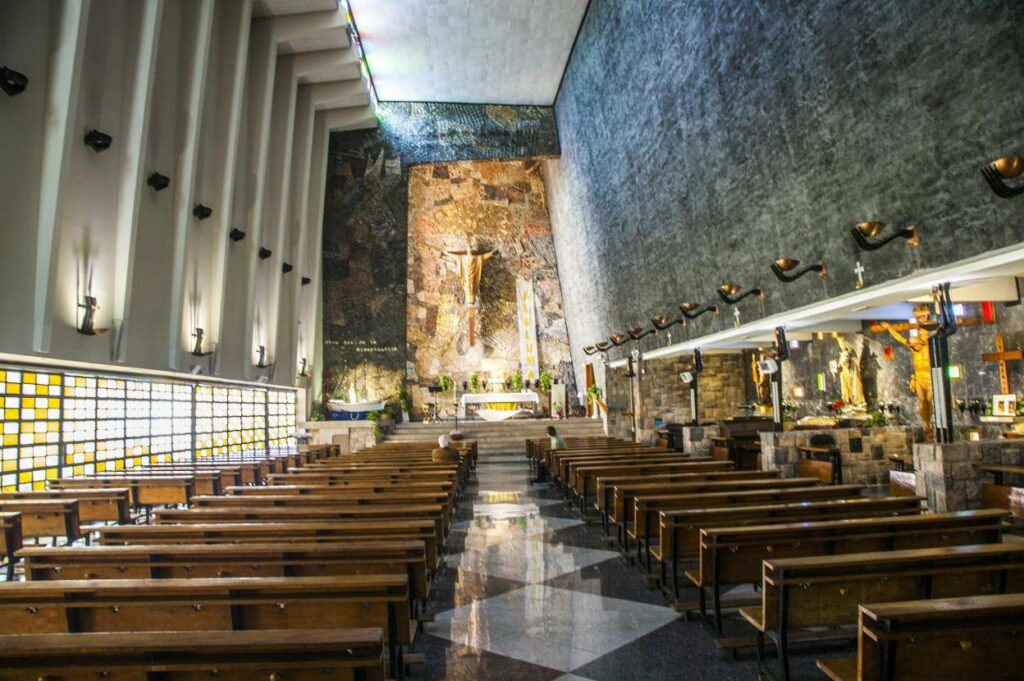
The nave has a trapezoidal plan that narrows the perspective towards the sanctuary. Above it rise two independent folded reinforced-concrete shells, spanning approximately 28 metres without supports in the middle of the worship space. Two post-tensioned cables help absorb the torsional forces created by this asymmetrical composition.
The gap between the roofs admits a strip of overhead light. Other lateral openings illuminate the walls and make the ceiling appear lighter than its material suggests. Exposed concrete, red brick, stone, ceramics and iron show how structure and finish were conceived as a single piece of architecture, without hiding the function of each element.
What to see in the Church of St Nicholas
- The nave and sanctuary: the plan directs the eye towards the altar and reveals the effect of the roof with no intermediate supports.
- Nassio Bayarri’s ceramic mural: a large abstract and symbolic composition presides over the high altar.
- The side chapels: grouped along the southern side, they can be visually integrated into the nave through their low dividing walls.
- The arcaded cloister: its irregular pentagonal plan fits the plot and links the church with the presbytery.
- The harbour façade: the porthole, maritime-inspired doors and outdoor image of Our Lady of Mount Carmel strengthen the connection with the fishing community.
The building’s importance has been recognised by its inclusion in the DOCOMOMO Ibérico register of Modern Movement architecture. In 2024, the Generalitat Valenciana also began proceedings to declare it an Asset of Cultural Interest in the monument category.
Practical information for your visit
- Location: Avinguda de la Pau, 2, opposite the port of the Grau of Gandia — view on the map.
- Admission: this is an active place of worship, and entry is free while the church is open. Avoid service times if you would like to appreciate the architecture quietly.
- Opening times: these vary with the season and liturgical calendar. Before travelling, check the notices published by the Parish of St Nicholas.
- During your visit: keep noise to a minimum and respect areas reserved for worship. The exterior and the view from the harbour basin are also essential parts of the experience.
A walk that explains the Grau
St Nicholas is best visited as part of a walk around the port. From the church, continue towards the harbour basin, the historic sheds, the Torre del Rellotge, the fish market and the Moll dels Borja. This route moves from modern architecture to industrial and fishing heritage without leaving the district.
The relationship with the sea continues at the table: discovering the history of Gandia’s fideuà helps explain how fishing boats and port cuisine form part of the same cultural landscape surrounding the church.