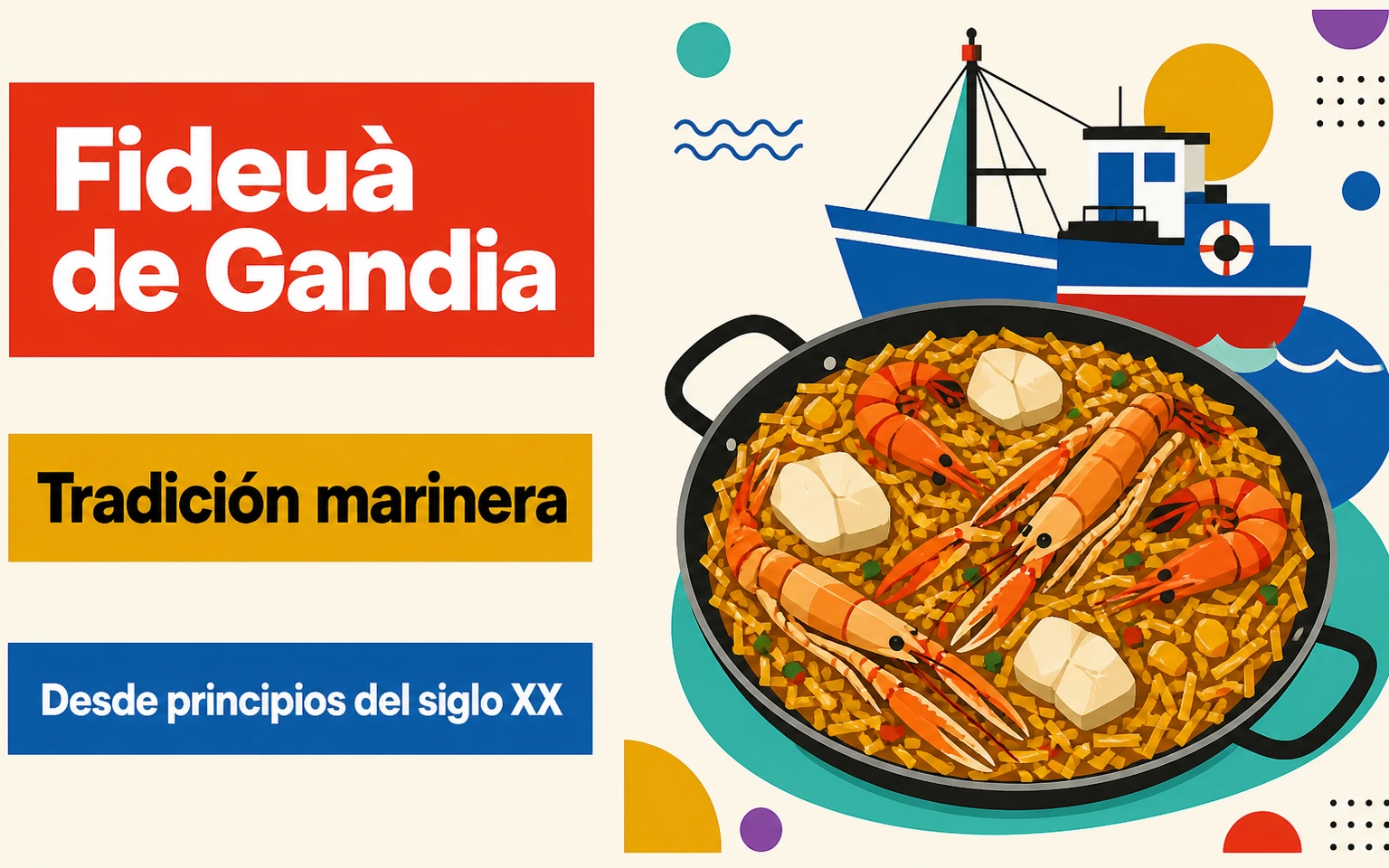
Fideuà de Gandia grew out of El Grau’s seafaring culture and became the city’s most recognisable dish. Its story brings together an invention passed down orally, the recipe’s evolution in the port’s restaurants and half a century of culinary competition.
Contents
To talk about fideuà is also to talk about El Grau de Gandia, its fishing boats and a cuisine that made the most of produce from the Mediterranean. The dish is part of the history of Gandia, even though its origins are not documented with the precision of a written recipe or an official record.
How fideuà was born aboard the Santa Isabel
Local tradition places the birth of fideuà in the early twentieth century, often around 1930, aboard the Santa Isabel, a trawler or bou fishing boat that operated out of El Grau. The date is approximate, and the story has reached the present day through several oral versions.
One version centres on the cook Gabriel Rodríguez Pastor, ‘Gabrielo’, assisted by the young Juan Bautista Pascual, ‘Zábalo’. According to this account, Gabrielo replaced the rice with noodles in the hope that the skipper, who was very fond of arroz a banda, would eat less and leave a larger portion for the crew. The result proved more popular than expected.
Another version attributes the improvisation to Zábalo: while preparing the meal, he discovered that there was no rice left and used noodles instead. No contemporary documentation allows either explanation to be considered definitive. What both share is the setting —a day’s fishing aboard the Santa Isabel— and a simple idea: transferring the flavours of a fisherman’s stew to noodles.
From a fisherman’s cauldron to dry paella
The first versions prepared on board are thought to have been moist and cooked in a cauldron, a more practical vessel on a boat. The dish’s history then entered a second stage on land. The Asociación Gastronómica Fideuà de Gandia links the chef Emilio López Bonías with the establishment of dry fideuà cooked in a wide, shallow paella pan at Hotel Europa in El Grau from 1960 onwards.
This attribution does not have to erase the Santa Isabel tradition: one thing is the popular birth of the idea, and another is its transformation into the dish that restaurants would later serve. El Grau’s restaurants helped establish its dry character, its presentation in a paella pan and its inseparable association with Gandia.
What goes into fideuà de Gandia
As with many traditional dishes, there is debate about the thickness of the noodles, as well as numerous modern variations. On this blog, our reference is the previously published traditional fideuà de Gandia recipe: for six people it uses number 4 noodles, langoustines, prawns, monkfish, tomato, garlic, paprika, onion, saffron, olive oil and fish stock.
Preparation begins by sautéing the shellfish. The garlic, paprika and tomato are then added; the monkfish goes in without being cooked all the way through. The stock is poured in and, once it boils, the noodles are added and cooked over a medium heat. The flavour depends as much on the seafood stock as on the final stage, when the liquid has been absorbed and the noodles retain their texture.
The competition that turned a local recipe into a symbol
The third major stage began on 20 June 1975, when Hotel Bayren hosted the first Concurso Internacional de Fideuà de Gandia. This hospitality-sector initiative gave the dish its own platform, bringing chefs together, comparing techniques and spreading the name of Gandia within Spain and abroad.
Hotel Borgia is also part of the competition’s history: in 1993, it won the Concurso Internacional de Fideuà de Gandia, an accolade that directly connects our hotel with the culinary tradition shared today through this blog.
The competition reached its 51st edition in 2026 and remains one of the city’s gastronomic landmarks. Beyond each year’s winners, its lasting legacy has been to turn a recipe from El Grau into shared heritage and a gateway to local culture.
A tradition to discover in El Grau
Eating fideuà in Gandia connects the dish with its landscape. The harbour, fish market, sheds and Moll dels Borja recall the maritime activity that explains its origins. Close by, the church of San Nicolás de Bari, designed like a ship facing the water, completes a visit to El Grau’s heritage.
Fideuà de Gandia does not need a single, definitive legend to retain its appeal. Its stories, its journey from cauldron to paella pan and the continuity of the competition show how a solution born at sea became culinary culture. To learn more about the competition’s history and the work of promoting the dish, visit the official website of the Asociación Gastronómica Fideuà de Gandia.