Joanot Martorell was the author of Tirant lo Blanch, known in Spanish as Tirante el Blanco. A knight from a family with ties to Gandia, he drew on his experience of court life, disputes over honour and everyday affairs to write a novel that holds a prominent place in European literature.
Contents
Who was Joanot Martorell, and how was he connected to Gandia?
Martorell was born probably in València around 1410–1411 and died in 1465. His family belonged to the lesser Valencian nobility and had roots in Gandia: his grandfather Guillem served at the ducal court before the Borja family acquired the lordship. The history of the Duchy of Gandia helps explain the world from which the Martorell family came.
Family ties also connect his biography with Ausiàs March, who married his sister Isabel. Difficulties in guaranteeing her dowry led to disputes between the two families. Money, inheritance and social standing carried as much weight in knights’ relationships as the ideals they professed.
A knight’s letters of challenge and travels
The lletres de batalla, letters containing accusations and challenges, offer an insight into Martorell’s character and the conflicts of his time. One of the best-known disputes involved his relative Joan de Monpalau, who had broken a promise to marry Damiata, another of the writer’s sisters.
Seeking to settle the dispute through combat, Martorell approached Henry VI of England to act as an impartial judge. He stayed in England between 1438 and 1439, although the duel never took place. He also travelled to Portugal and Naples. Contact with European courts gave him a knowledge of ceremonies, power relations and chivalric customs that reappears in his writing.
When he wrote Tirant and how it reached print
Martorell began writing Tirant lo Blanch in 1460. He faced serious financial difficulties during his final years and, in 1464, pledged the manuscript as security for a loan from Martí Joan de Galba. A later claim by his brother Galceran forms part of the documentary evidence that establishes his death in 1465.
The first edition appeared in València in 1490, twenty-five years after the writer’s death. Galba’s role has prompted a long debate: the original colophon credited him with a part in the work, while modern studies have questioned his status as co-author. Martorell’s authorship provides firm ground from which to approach the novel.
What Tirant lo Blanch is about and why it still appeals
The novel follows Tirant, a knight whose military reputation takes him to Constantinople to help defend the empire. There he falls in love with Carmesina, the emperor’s daughter. Campaigns, negotiations and palace life intertwine with desire, jealousy and romantic intrigues, in which the resourceful Plaerdemavida plays a part.
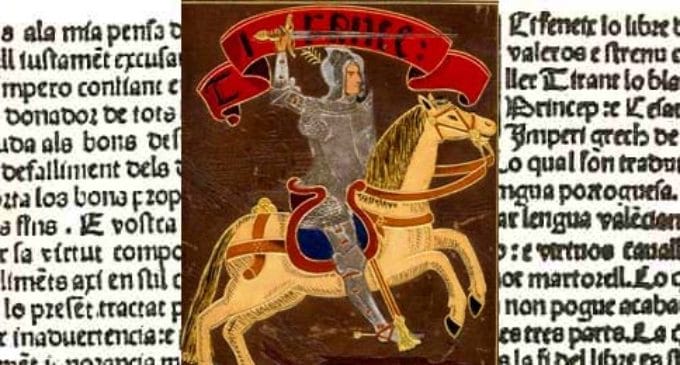
Much of its appeal lies in its variety of registers: military strategy sits alongside humour and intimacy. The hero makes mistakes, feels embarrassed, suffers injuries and depends on other people. Attention to the body and human frailty helps explain why the book is considered a precursor of the modern novel.
Cervantes praised it in Chapter VI of the first part of Don Quixote: while examining the library, the priest highlights the natural behaviour of its knights and saves the book from the fire, along with other works. Tirant belongs to the Valencian Golden Age, the literary world of the fifteenth century in which March and Joan Roís de Corella also wrote.
Remembering Martorell in Gandia today
A good place to explore literary Gandia is the Biblioteca Central Convent de Sant Roc, at Plaça Rei Jaume I, 10. It occupies part of the former convent of Sant Roc and has a sculpture of Tirant in one of its courtyards. Before visiting, check the municipal libraries’ opening hours and confirm access to the courtyard.
From the library, you can continue along Carrer Major towards Plaça Major and complete a walk through the centre of Gandia. The walk introduces you to the streets and heritage of a city that celebrates its classic writers.
The connection continues through contemporary writing: since 1979, Gandia has awarded the Premi Joanot Martorell de Narrativa. It forms part of the Premis Literaris Ciutat de Gandia alongside the Ausiàs March poetry prize. Details of the awards and activities are available from the IMAB.
Where to start reading Martorell
For a first reading, the adventures of Tirant and Carmesina offer an introduction to the novel’s humour and court life. An annotated edition helps with medieval vocabulary and customs; the letters of challenge then allow you to compare the novelist’s voice with the knight’s. The Biblioteca Virtual Miguel de Cervantes brings together the text, a biography and studies for further reading.