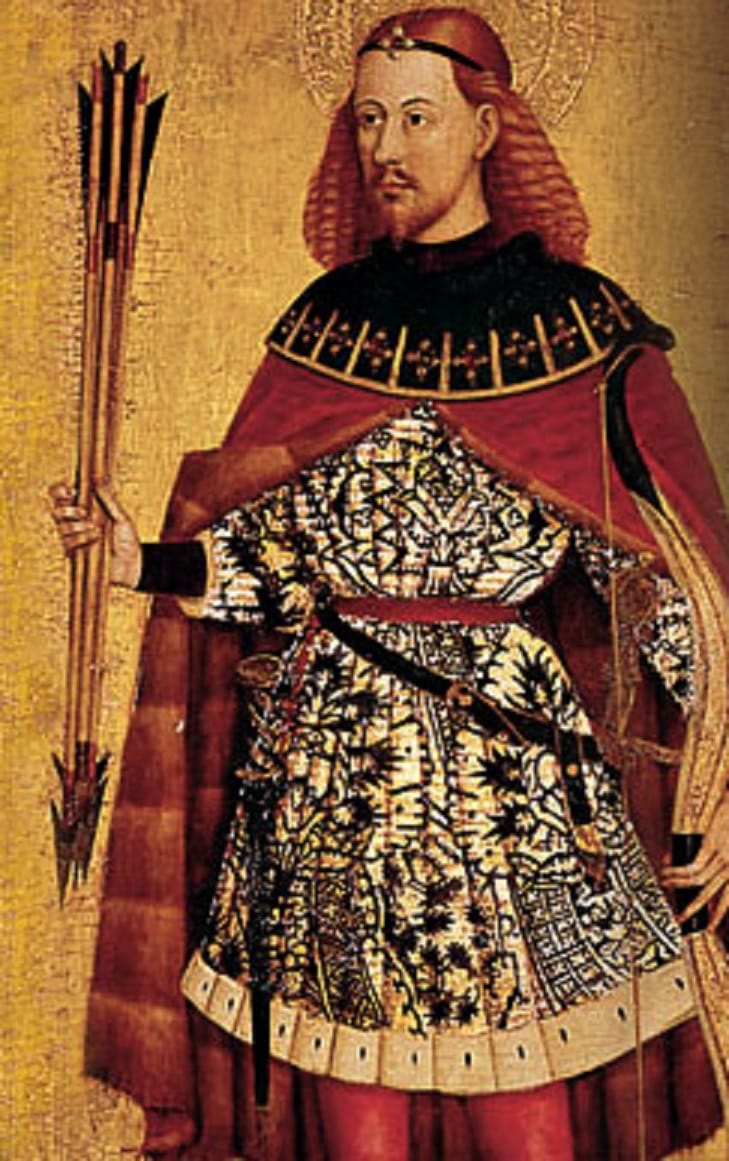
Ausiàs March (c. 1400 — Valencia, 1459) is the great poet of the Valencian Golden Age: a knight, royal falconer and lord of Beniarjó who dared to write learned poetry in Valencian when everyone else still rhymed in Occitan. His whole life runs through Gandia and its surroundings, and today you can follow in his footsteps while barely leaving the city.
Contents
Who was Ausiàs March
The March family had been rooted in these lands since the land distribution that followed the conquest of Jaume I, in the thirteenth century. His father, the poet Pere March, was steward and procurator general to Alfons el Vell, the first royal Duke of Gandia, and young Ausiàs trained as a knight at the ducal court — the same court evoked today by the Palau Ducal. As for his birth, around 1397–1400, the documents leave the question open: tradition places it in Gandia or Beniarjó, though recent research points to the city of Valencia.
Knighted in 1419, he fought between 1420 and 1424 in the Mediterranean campaigns of Alfonso the Magnanimous — Sardinia, Corsica, Sicily and the siege of the island of Djerba. In 1425 the king appointed him royal falconer of the Kingdom of Valencia, a post he held until 1430, overseeing the royal falconry on the Albufera. He then hung up his arms and returned to his estates, a stone’s throw from Gandia.
The lord of Beniarjó and the sugar of the Serpis
March held seigneurial jurisdiction over Beniarjó and the hamlets of Pardines and Vernissa. Far from merely collecting rents, he promoted the growing of sugar cane, set up a sugar mill — the trapig — and had a weir built on the river Serpis, together with the irrigation channel that still bears his name, the Séquia de March or Séquia Mare. The most tormented poet of his century was also a country lord with his feet in the mud of the huerta.
Two marriages and a brother-in-law called Joanot Martorell
In February 1439 he married Isabel Martorell, sister of Joanot Martorell, the author of Tirant lo Blanch. The wedding came after two years of lawsuits with the bride’s family over the dowry, complete with letters of battle and threats of a knightly duel. Isabel died only a few months later, in September of that same year; forensic studies carried out after the discovery of the family crypt revealed that she was pregnant. In 1443 March married his second wife, Joana Escorna, who died in 1454 leaving him as her heir. He had no legitimate children from either marriage, though at least five were born outside them.
His father and both his wives rest in the March family crypt at the monastery of Sant Jeroni de Cotalba, rediscovered in 2016 beneath the chapel of the Virgen del Rosario. The poet dictated his will in October 1458 and died on 3 March 1459 at his house in Cabillers street, Valencia.
The work: 128 poems that changed poetry
His surviving work amounts to 128 poems and more than ten thousand lines, traditionally grouped into songs of love, songs of death, moral songs and the Cant espiritual. March was the first poet in the Iberian Peninsula to write learned verse entirely in Valencian, free of the formulas of troubadour Occitan, and he replaced the ideal of courtly love with something far more modern: introspection, doubt and the conflict between flesh and spirit. Together with Joanot Martorell and Joan Roís de Corella, he forms the great triad of the Valencian Golden Age.
In his love poems he never named the real woman: he addressed her through five poetic signals, or senyals:
- Plena de seny (Full of reason)
- Llir entre cards (Lily among thistles)
- Amor, amor
- Mon darrer bé (My last good)
- Oh, foll amor (Oh, mad love)
This is how he sounds, with an English prose translation:
Així com cell qui en lo somni·s delita
e son delit de foll pensament ve,
ne pren a mi: que·l temps passat me té l’imaginar, que altre bé no hi habita, sentint estar en aguait ma dolor,
sabent de cert que en ses mans he de jaure.
Temps d’avenir en negun bé·m pot caure;
ço que és no-res a mi és lo millor.
Del temps passat me trob en gran amor,
amant no-res pus és ja tot finit. D’aquest pensar me sojorn e·m delit, mas quan lo perd, s’esforça ma dolor:
sí com aquell qui és jutjat a mort
e de llong temps la sap e s’aconhorta,
e creure·l fan que li serà estorta,
e·l fan morir sens un punt de record.
Like one who takes delight in dreaming, with a mad, imagined pleasure,
so it is with me: for time gone by grips my mind, and no other good dwells there,
feeling my sorrow lying in wait,
knowing for certain I must lie in its hands. From time to come no good can reach me;
what is nothing is, for me, the best.
Beyond all measure I love the past,
which is to love nothing, for it is gone;
in this thought I dwell and take delight,
but when I lose it my pain grows stronger,
like the man condemned to death, who has long known it and takes comfort, and, made to believe he will be spared,
is led to die without a moment’s warning.
From Garcilaso to today: his influence
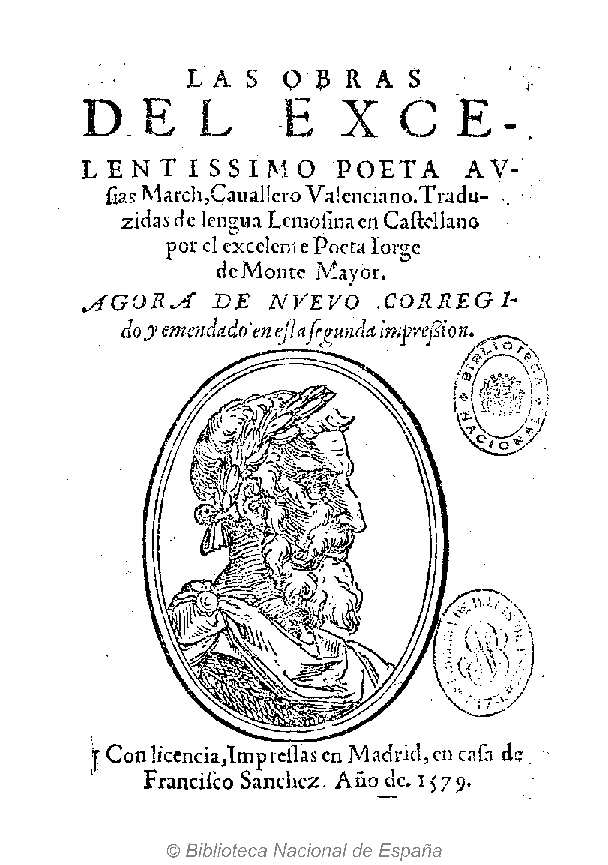
March was essential reading for the Castilian Renaissance: he influenced Juan Boscán, Garcilaso de la Vega, Diego Hurtado de Mendoza and Fernando de Herrera, and his verses soon circulated in Spanish thanks to the printed translations of Baltasar de Romaní (1539) and Jorge de Montemayor (1560). Six centuries on, he remains the greatest classic of literature in Valencian.
In the footsteps of Ausiàs March from Gandia
In Gandia
The city honours the poet with his monument near the Centre Històric and with the Parque Ausiàs March, the large green space on the banks of the Serpis. Every year the town council also awards the Premi Ausiàs March de Poesia as part of the Premis Literaris Ciutat de Gandia, one of the longest-running and most prestigious poetry prizes in the Valencian language; the dates of each edition vary.
In Beniarjó, his lordship
Some 5 km from Gandia, Beniarjó preserves the layout of the old March manor house next to the church of San Juan Bautista, the Séquia de March and a signposted route through the water heritage of the old lordship. During its patron saint festivities the village also awards the Premi de Poesia Senyoriu d’Ausiàs March.
Sant Jeroni de Cotalba and Valencia
At the monastery of Sant Jeroni de Cotalba, 8 km from Gandia in Alfauir, the guided tour takes in the monument where the poet’s family rests; check current opening times and tickets at cotalba.es. And in Valencia Cathedral, about 50 minutes away by car or commuter train, a stone slab laid in 1950 near the Puerta de la Almoina honours the site of his burial.
Location of Beniarjó (map)
Images