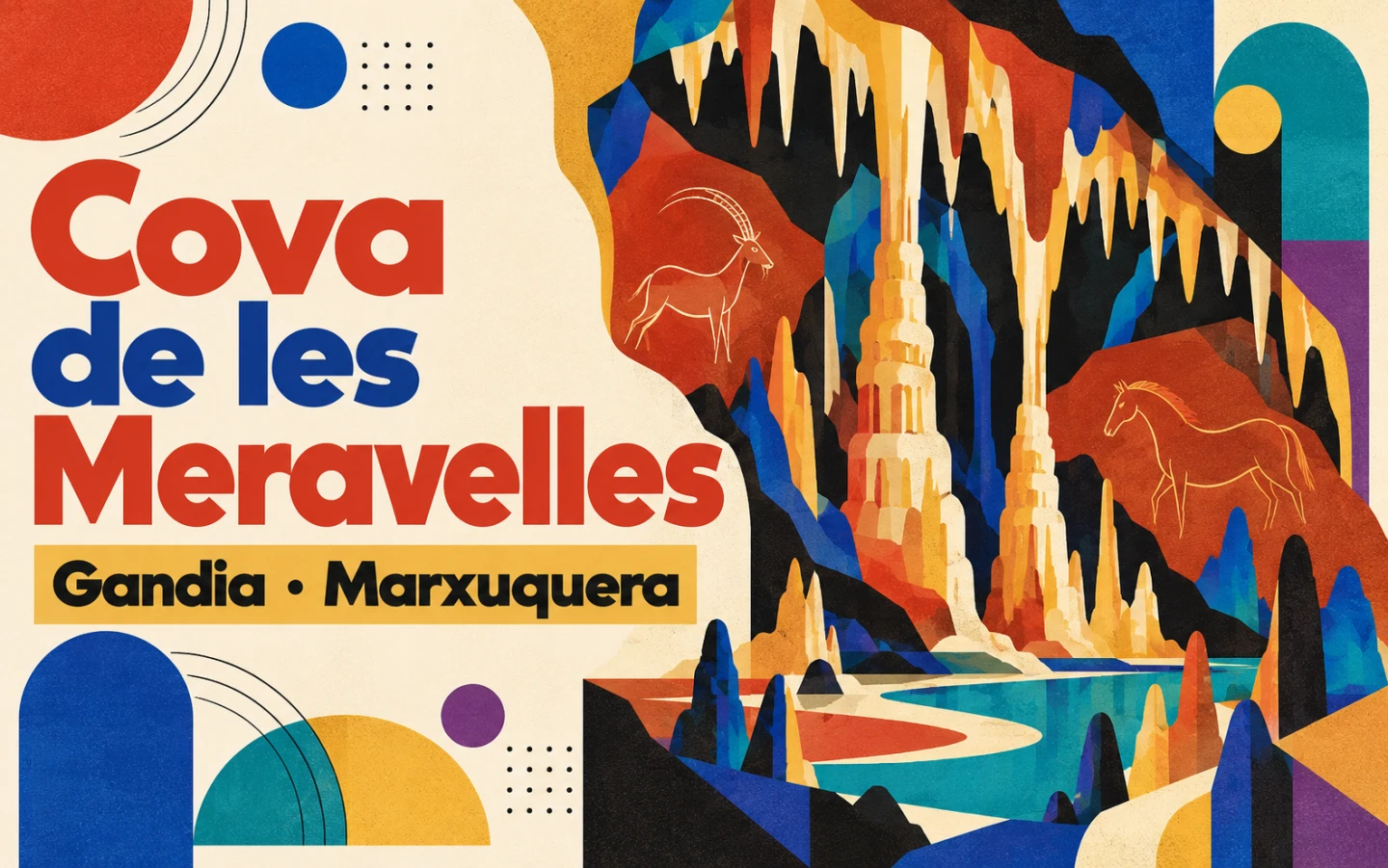
The Cova de les Meravelles in Gandia, in the Serra Falconera, preserves Upper Palaeolithic engravings among stalactites, stalagmites and mineral columns. A guided visit offers an introduction to an archaeological site in Marxuquera Alta, reached by a mountain path with a demanding climb.
Contents
Where the cave is and what it contains
The cave opens onto the Serra Falconera, above the rural landscape of Marxuquera, within the municipality of Gandia. The Morabit de Marxuquera, at the foot of the hills, is the meeting point for organised visits and introduces visitors to rural life in the valley.
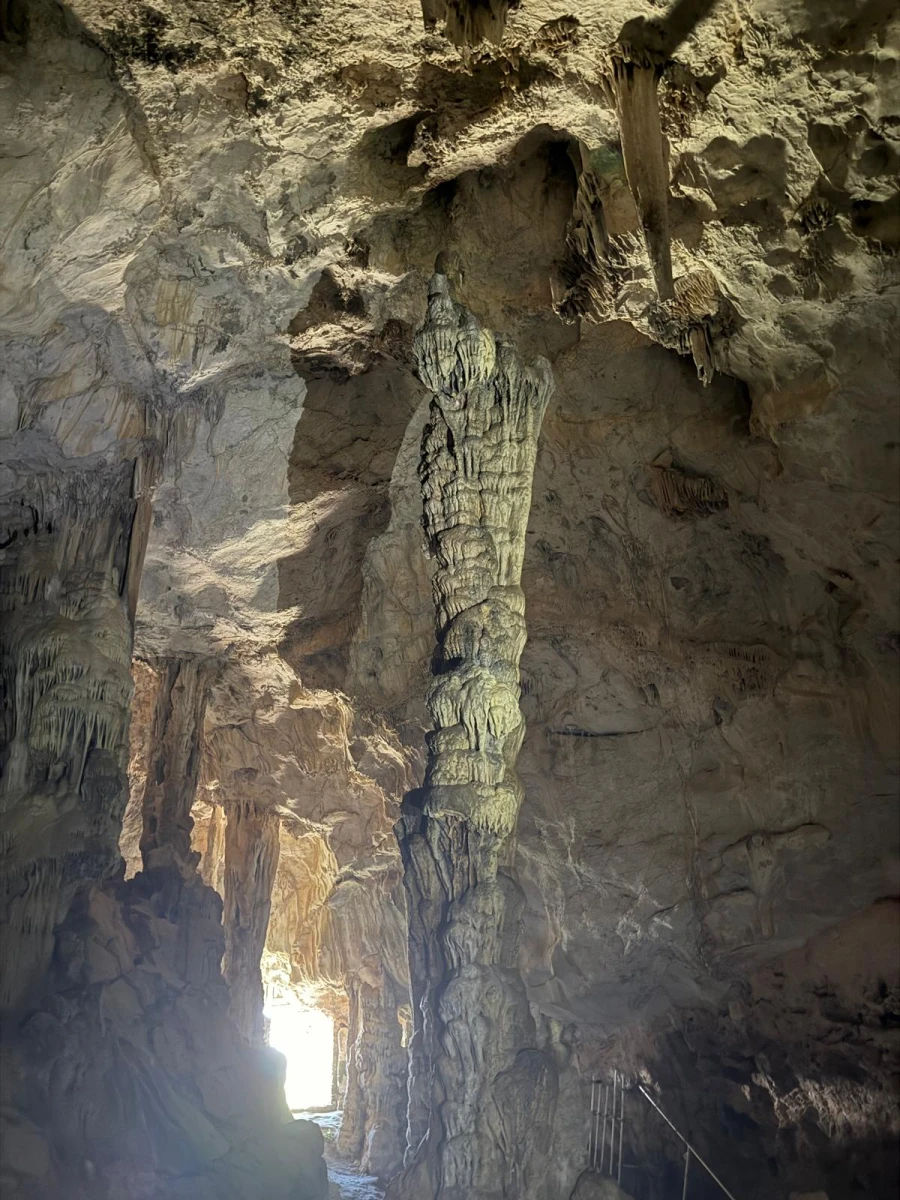
Inside, mineral formations slowly created by water stand out: stalactites hanging from the ceiling, stalagmites rising from the floor and columns joining the two. Moisture and calcite deposits also affect the preservation and visibility of the engravings.
The Palaeolithic engravings and what research has revealed
The archaeologist Carles Miret identified the rock art in 2003. The figures consist of fine incisions in the rock. Overlapping lines and mineral deposits make them difficult to read, so the guide’s explanations help when viewing the panel; visitors should not expect to make out every animal with the naked eye.
The doctoral thesis by Ana Cantó Núñez, defended at the Universitat de València in 2024, documented 36 animal figures and 265 signs on the main panel. Recognisable animals include goats and horses. Photography under different lighting conditions and three-dimensional models have helped researchers study very shallow lines and expand earlier inventories.
The rock art dates to the Upper Palaeolithic. Research links it to Mediterranean art from before the Magdalenian period and compares it with the plaquettes from the Cova del Parpalló. Dating the calcite covering some of the grooves provides a minimum age; establishing exactly when each figure was made remains a separate question.
A history of visits, excavations and losses
Excavations in 1932, involving Luis Pericot, and in 1953, led by Enrique Pla Ballester, helped establish the cave’s prehistoric occupation. Neolithic, Iberian and Roman materials have also been recovered, providing evidence of uses and visits at different times. The historical signatures and inscriptions preserved on the walls date from later periods than the Palaeolithic art.
In the early 17th century, Gaspar Juan Escolano described the formations and recounted how Carlos de Borja had ordered some to be removed for use as fountain jets in his garden. The account connects the cave with the history of the Borja dukes and recalls the losses suffered by its natural heritage.
Planning a visit to the Cova de les Meravelles
Access is by guided tour booked in advance. To help visitors assess the climb, Gandia’s official tourism information gives the following details:
- Meeting point: Morabit de Marxuquera.
- Distance: 1.25 km one way.
- Ascent: 195 m.
- Difficulty: moderate/high, on a path over uneven ground.
- Recommended equipment: suitable footwear, water and a hat.
If you are travelling with children or have mobility difficulties, check whether the route is suitable before booking. Confirm the available tour, price and meeting instructions on the official Cova de les Meravelles page or by calling +34 96 295 95 40.
The cave is protected as a Bien de Interés Cultural, a designated cultural heritage site, because of its rock art. During the visit, follow the guide’s instructions and avoid touching the walls, engravings and formations. For a broader understanding of local prehistory, the Gandia Archaeological Museum (MAGa) holds material from Meravelles and other sites in La Safor.
For a closer look at the engravings, see Ana Cantó Núñez’s study at the Universitat de València.