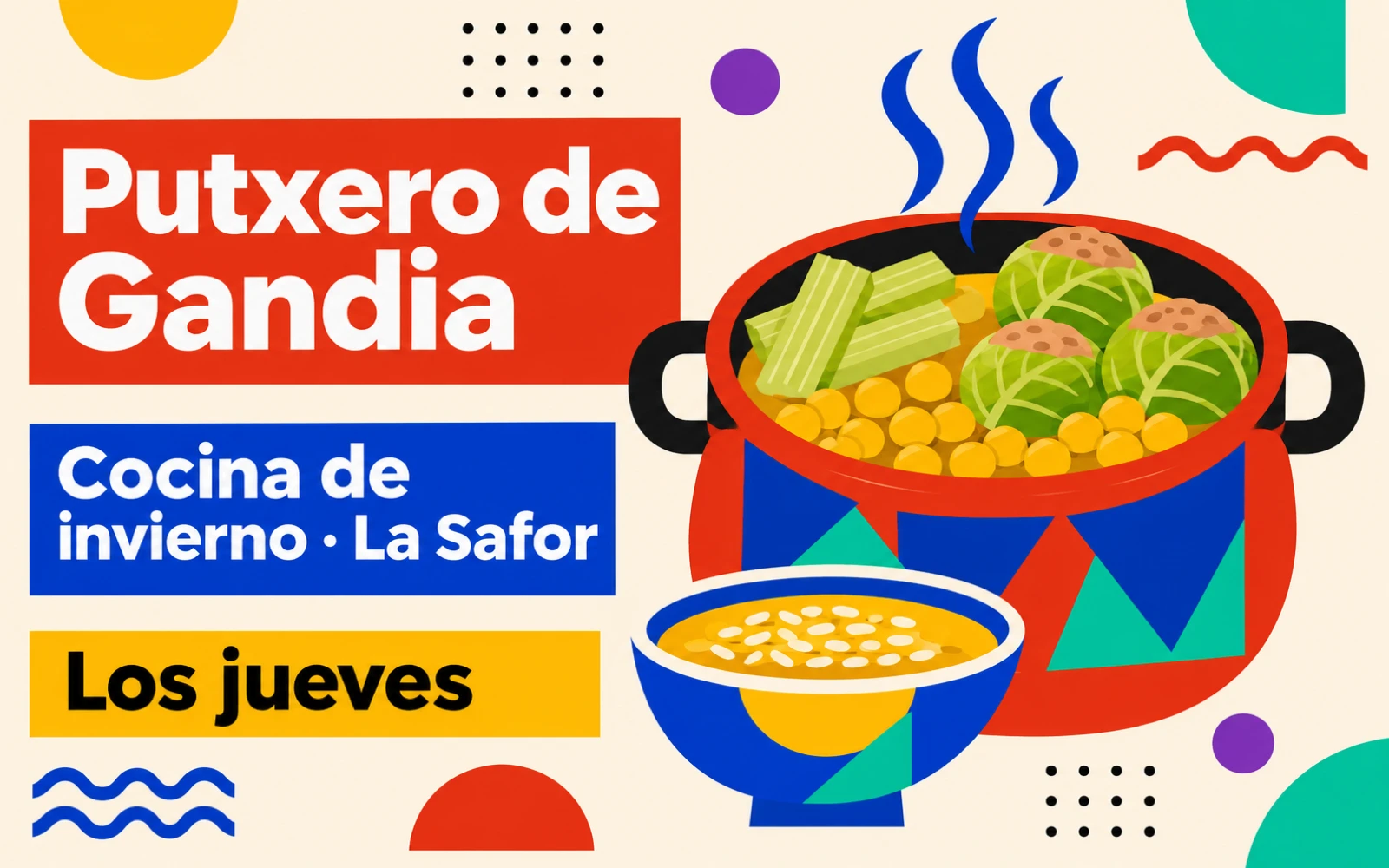
The putxero of Gandia fills the house with the aroma of stock over some four hours of slow cooking, and is traditionally enjoyed on Thursdays in autumn and winter in Gandia and across La Safor.
Contents
Chickpeas, cardoon stems, hen, beef, blanquet and spiced pilotes wrapped in cabbage leaves share the pot until the golden stock is ready to serve with rice. The stew belongs among the lesser-known traditional dishes of Gandia, made for cold days and family gatherings.
A winter stew with Mediterranean roots
The name comes from the Latin puls, a cereal porridge cooked in water in Roman times. Andalusi cooking added spices such as saffron, cinnamon and clove, along with cardoon stems. After the Christian conquest of the 13th century, Valencian households took up beef and pork. In La Safor the recipe has passed down by word of mouth and remains a dish for Thursdays, Sundays and Christmas.
The pilota gives the stew much of its character. The mixture combines minced pork, egg, parsley, pine nuts, lemon zest, cinnamon, clove, nutmeg and black pepper. Each piece is wrapped in half a cabbage leaf and secured with a cocktail stick.
How it is served at the table
The classic service divides the pot into two courses. The soup comes first, with freshly cooked stock and rice (between 50 and 75 g per person). A platter follows with the chickpeas, the vegetables, the meats, the blanquets and the pilotes. For storage, keep the stock and the solids separately and reheat with a lid over a gentle heat.
Recipe to serve 6
Soak the 400 g of dried chickpeas for 12 hours and follow the order in which the ingredients join the pot.
- Pulses and vegetables: 400 g dried chickpeas, 6 cardoon stems, 2 celery sticks, 2 leeks, 2 turnips, 5 carrots, 2 parsnips, 3 medium potatoes, 1 bay leaf, saffron threads, salt and 5 litres of water. You can add 500 g of pumpkin in chunks for a touch of sweetness; many homes in La Safor leave the pumpkin out.
- Meat and sausage: 400 g beef shank, 400 g hen or chicken, 2 blanquets, 100 g pancetta or fresh pork belly and between 1.1 and 1.2 kg of bones (knuckle, cheek and rib).
- For the pilotes: 750 g minced pork, 2 eggs, chopped parsley, a handful of pine nuts, zest of 1 lemon, 1/4 teaspoon cinnamon, 1/4 teaspoon ground clove, 1/4 teaspoon nutmeg, 1/4 teaspoon black pepper, salt, breadcrumbs to adjust the consistency and 2 or 3 cabbage leaves for wrapping.
Shape 4 to 6 oval pilotes, wrap each one in half a cabbage leaf and add breadcrumbs if the mixture feels soft. Place the chickpeas, the bones, the hen and the shank in a large pot, cover with the water and skim the foam as the pot comes to the boil. After 1 hour, add the cardoon, the celery, the leeks, the turnips, 4 carrots, the salt and the saffron, and keep a gentle simmer for 1 hour to 1 hour and a half. Add the potatoes, the remaining carrot, the pancetta, the blanquets and the pilotes, and cook for a further 1 hour to 1 hour and a half, up to about 4 hours in total. Cook the rice in part of the stock.
The seaside version: putxero de polp
In Valencian coastal towns, fishing families make putxero de polp with octopus in place of the meats. The pot keeps potato, cardoon stem, cabbage and saffron, with the same unhurried cooking and rice served in the stock.
What to drink and how to use the leftovers
The stock tastes rich and slightly sweet from the vegetables and the saffron, with the spiced depth of the pilotes in the background. A full serving provides between 600 and 800 kcal. At the table, structured reds from the Valencia or Utiel-Requena denominations (Garnacha or Monastrell) work well, with a Valencian mistela or an herbero to finish the meal.
Set aside some stock and solids for the next day: home cooking in La Safor turns the leftovers into Gandia-style baked rice or croquettes. The fideuà of Gandia stands as the best-known seafaring dish in the city, with the putxero offering an inland winter counterpart built around a shared pot.