
In the Centre Històric of Gandia there is a square, a church and a set of ceramic panels dedicated to a friar from Murcia who spent his last ten years here. Andrés Hibernón died in the convent of Sant Roc on 18 April 1602, and the city has called him el Beatet ever since.
Contents
His life story is usually reduced to a few lines alongside the history of the building where he is venerated, and it is worth following in full: that of a lay brother with no office or education whose memory ended up giving its name to a square and to a diocesan shrine.
From shepherd in Valencian lands to lay brother
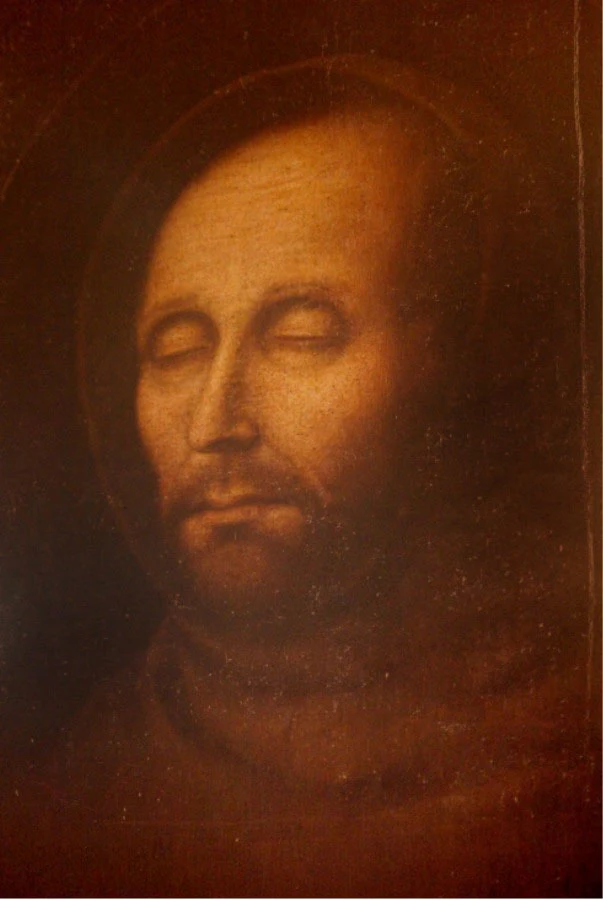
Andrés Hibernón Real was born on 30 November 1534 in the city of Murcia, at the home of a maternal uncle who was a canon of the cathedral, where he was baptised. The family lived in Alcantarilla and he spent his childhood there, among the farm work of a minor noble household fallen on hard times.
At fourteen he left for Valencian lands to serve an uncle of his, Pedro Ximeno, and worked as a shepherd for six years. With his earnings he saved eighty silver ducats intended as his sister’s marriage dowry. On his way home, bandits attacked him on the road and took every last coin.
The robbery marked his break with secular life. After a brief spell working in Granada, on 3 October 1556 he entered the convent of San Francisco in Albacete, of the Conventual Franciscans, as a postulant, and professed as a lay brother on 1 November 1557. He never became a priest: his were always the community’s manual tasks.
Joining the Alcantarine discalced friars
Seeking a stricter rule, between 1563 and 1565 he obtained permission in Elche to join the discalced reform promoted by Saint Peter of Alcántara. There began an itinerant life around the convents of the Alcantarine province of San Juan Bautista: Elche, Almansa, Villena, Jumilla, Valencia and Murcia.
Along the way he met Saint Paschal Baylón, a fellow Alcantarine friar with whom he shared a friendship of mutual admiration until the latter’s death in 1592. Franciscan chronicles also link him to the archbishop of Valencia Saint John of Ribera and to the Dominican Saint Louis Bertrand.
Ten years in the convent of Sant Roc in Gandia
Around 1592 he arrived at the convent of Sant Roc in Gandia, where he would remain until his death. The complex was a recent foundation at the time: it had been built in 1588 by Carlos de Borja, 5th Duke of Gandia and son of Saint Francis Borgia, and the Alcantarine friars took possession of it in 1591. The Baroque church visitors see today came much later, in the 18th century.
During his final decade he served as almoner, doorkeeper and cook, combining physical work with a contemplative life. Begging for alms around the district brought him into daily contact with the people of La Safor, and explains much of the popular affection that surrounded him. His two central devotions were the Eucharist and the Immaculate Conception.
What the Franciscan tradition tells
The memory of el Beatet reaches us filtered through his order’s chronicles, particularly the Crónica de la Provincia de San Juan Bautista published by Friar Antonio Panes in 1665. Its pages credit him with more than a hundred wonders in the district: the multiplication of food, healings, episodes of bilocation and the announcement of his own death four years in advance.
The same tradition credits him with converting many Moriscos in La Safor through close dealings and charity, in the years before the expulsion decreed in 1609. All of it is best read for what it is, the pious storytelling typical of 17th-century hagiography: helpful for understanding the devotion the figure inspired, and not a verifiable historical record.
Death in 1602 and the birth of a devotion
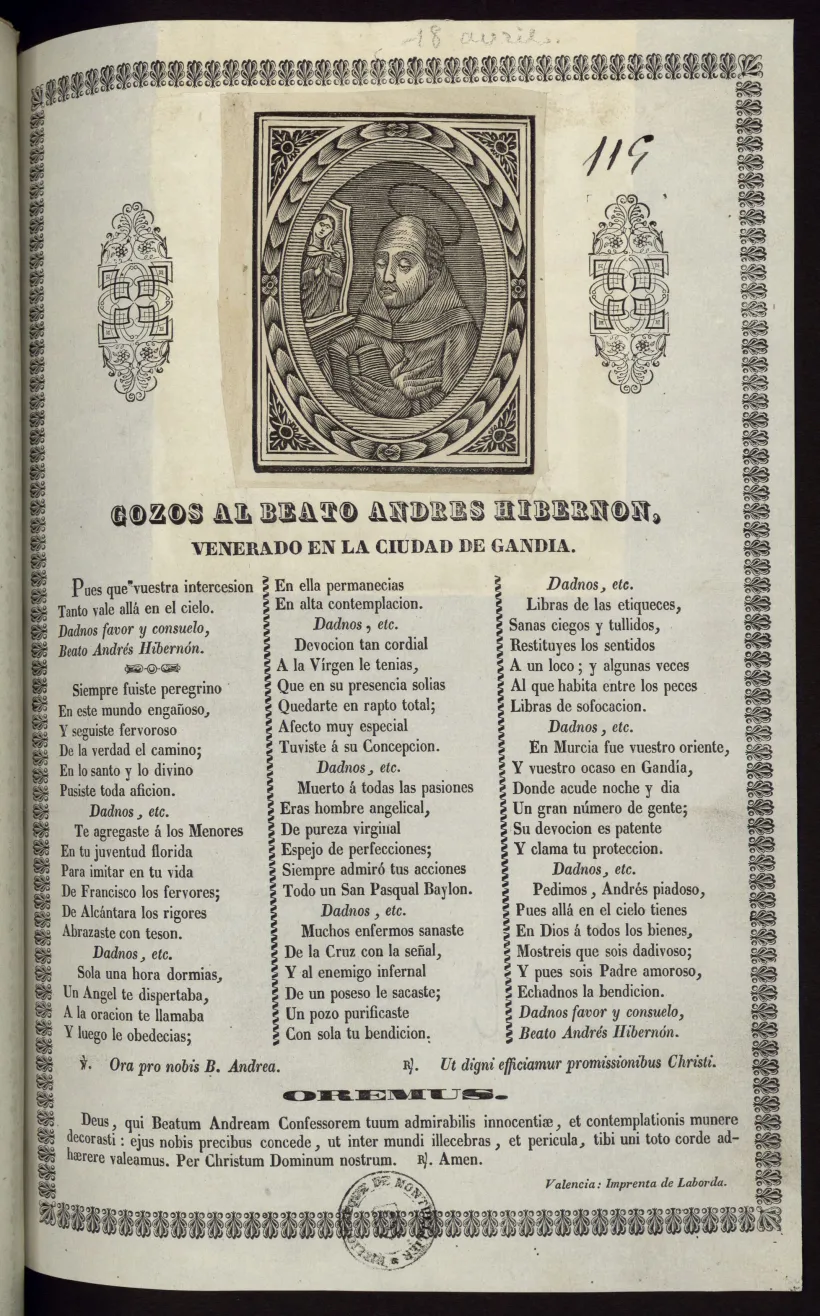
Friar Andrés died in the convent of Sant Roc on 18 April 1602. Popular devotion was immediate in Gandia and the neighbouring towns: gozos were printed in his honour and the Valencian diminutive by which he is still known took hold, el Beatet.
The ordinary process into his virtues concluded in the diocese of Valencia around 1623, although definitive recognition would take almost two more centuries: Pope Pius VI beatified him on 22 May 1791. The beatification left a physical mark on the city, since it prompted the building of the neoclassical chapel dedicated to the blessed in the church that had been his convent.
For centuries, descriptions of the tomb insisted that his body remained incorrupt, and it was venerated as such in Gandia until 1936. That year, during the Spanish Civil War, the grave was desecrated and the remains destroyed. The relics that were rescued are kept today between Alcantarilla and Murcia Cathedral.
What remains of el Beatet in Gandia today
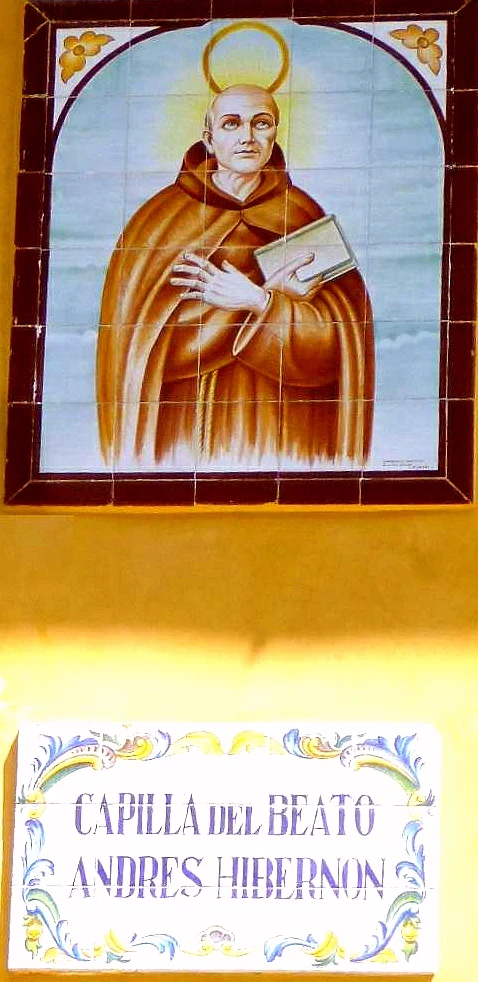
The friar’s presence is still easy to spot in the city centre. His name titles the pedestrian square in front of the church where he lived, and the Church of San Roque or del Beato preserves the chapel built after the beatification, the ceramic panels with scenes from his life and a life-size bronze statue in the street. In September 2022, the Archdiocese of Valencia raised the church to the rank of Diocesan Shrine of Blessed Andrés Hibernón.
The former convent that took him in now houses the Central Library of Gandia, and the complex is part of the Territorio Borgia urban route, so the visit can be combined with the other ducal settings of the Centre Històric.
As this is a place of worship, opening hours depend on parish activity; it is worth checking them with the official tourist information for Gandia before setting off. To read further, the entry in the Real Academia de la Historia and the Franciscan directory set out his full monastic itinerary.