Every December, Gandia revives one of the oldest rituals of European Christmas: El Cant de la Sibil·la, a medieval liturgical drama that heralds the Final Judgement and the birth of Christ, which the city experiences across two very different settings — the Insigne Colegiata de Santa María and the Ermita de Santa Anna.
Contents
If you are visiting Gandia over the festive season, this guide explains exactly what this ancient chant is, why the Gandia version is one of the most meticulously produced on the Iberian Peninsula, and how to attend either of its two celebrations.
What is El Cant de la Sibil·la
In Greco-Roman antiquity, the Sibyl was a prophetess inspired by the divine. Christian authors such as Saint Augustine reinterpreted her apocalyptic predictions as a pagan announcement of the Second Coming of Christ, and around the 10th century this prophecy became a chant: monophonic compositions in Latin inserted into Christmas Eve Matins. From the 13th century, the Crown of Aragon translated the verses into the vernacular tongues — Catalan and Valencian — set to a Gregorian melody that today remains one of Europe’s oldest and most enduring musical repertoires.
The Council of Trent (1545-1563) banned performance of this kind inside churches and the chant disappeared from almost all of Europe, surviving uninterrupted only in Mallorca and the Sardinian city of Alghero. In 2010, UNESCO declared Mallorca’s Cant de la Sibil·la an Intangible Cultural Heritage of Humanity, a recognition that drove its revival across the Valencian region. Gandia’s version has been declared an Intangible Property of Local Relevance by the Generalitat Valenciana since 2013, a status it shares with Easter’s Visitatio Sepulchri and the Tio de la Porra.
Two ways to experience it in Gandia
The city offers two complementary ways to experience the same rite:
- The intimate liturgy at the Ermita de Santa Anna: revived in 1979 by Father Vicent Faus Beltran and the Piarist Fathers, it forms part of the sanctuary’s Christmas tradition. A child treble voice sings the monophonic verses in the semi-darkness of the church, based on a textual version from a 1533 breviary of Valencia Cathedral adapted musically by Salvador Pla Faus. The date, time and access conditions must be confirmed for each staging.
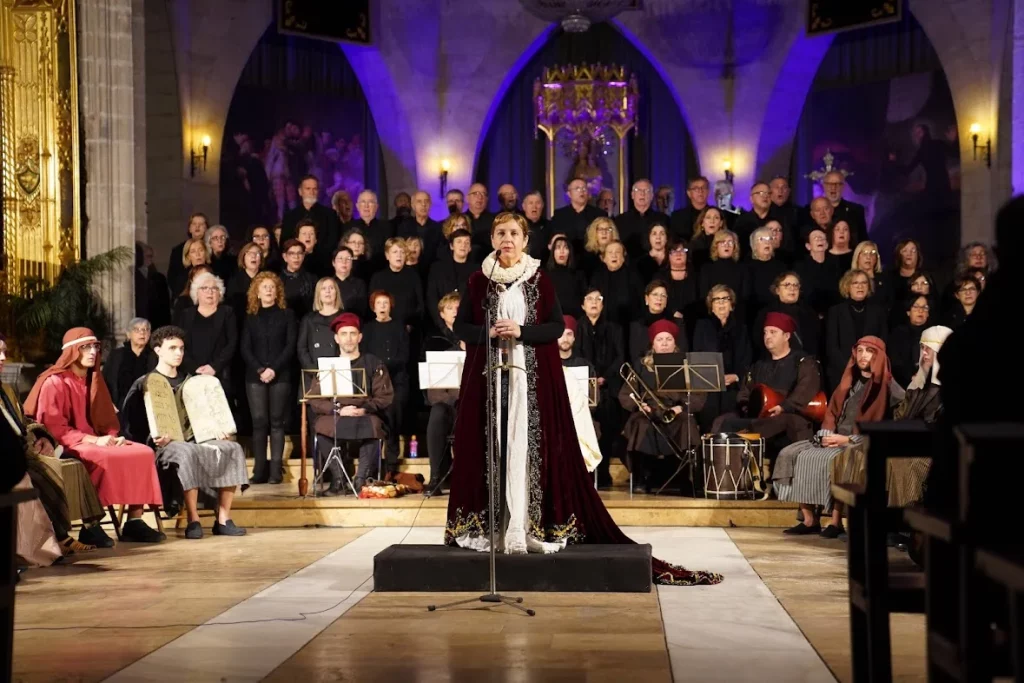
- The monumental performance at the Colegiata: since 2015, the Insigne Colegiata de Santa María has hosted a production in the days leading up to Christmas coordinated by artistic director Juan Miguel Terrazas Samper, bringing together over a hundred local performers, the result of an agreement between Gandia Town Council and the Colegiata Chapter.
The Colegiata performance: from the Dansa de la Mort to the sword of the Sibil·la
The show at the Colegiata is structured in two parts reflecting the two sides of the prophecy. The first begins with the Toc a Matines, the traditional manual bell-ringing, and addresses the Final Judgement with a staging of the Dansa de la Mort, a dance with late medieval roots performed by the Ballet de Alicia Montava from Cocentaina that serves as a reminder that death equates all social classes, from kings to labourers. Timpani and medieval wind instruments accompany the dramatic recital.
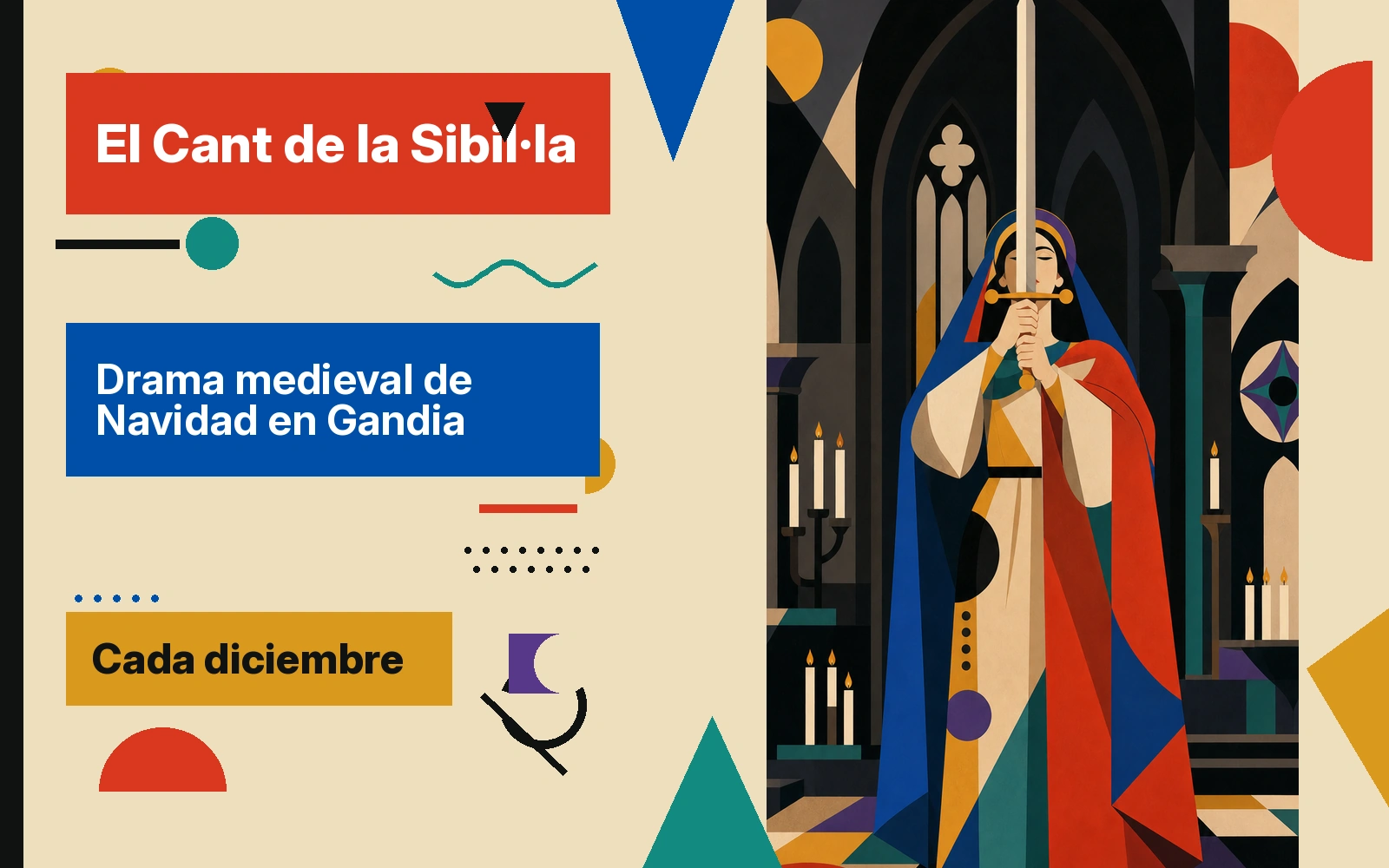
The second part gives way to hope with the Processó dels Profetes, coordinated by the Escola de Teatre Serrano de Gandia, in which Old Testament figures process along the naves of the church. The climax comes when the Sibil·la — a professional soprano attired in a silk tunic, headdress and embroidered cloak — raises a large sword with both hands in front of her face: the symbol of divine justice and the shattering of earthly time in the presence of eternity.
The Cançoner de Gandia, a musical treasure of the Renaissance
What musically distinguishes the Gandia version is the use of the Cançoner de Gandia, a 16th-century manuscript linked to the court of the Duke of Calabria in Valencia and the splendour of the Borgia Duchy, considered one of the most important collections of sacred polyphony on the peninsula. The prophetic stanzas are sung in monophony of Gregorian origin, whilst the choral refrains unfold four- and five-voice polyphonies by Renaissance composers such as Bartomeu Càrceres and Master Alonso. The landmark recording was made in 1997 by Carles Magraner with Capella de Ministrers.
On stage, this repertoire is performed by choirs and ensembles from right across La Safor and neighbouring regions: from the Cor Sant Blai de Potries to the Ensemble de Ministrils Ciutat de Gandia — playing replica period instruments — along with the Campaners de l’Alqueria de la Comtessa, who perform the traditional bell-ringing.
Practical information for attending
- Colegiata de Santa María (Plaza de los Apóstoles, Centre Històric): the performance is announced as part of each edition’s Christmas schedule. The date, time, door opening times and capacity may vary, so they should be confirmed prior to travelling.
- Tickets for the Colegiata: the entry requirements, any suggested donation, its recipients and point of sale locations are communicated alongside each programme. Check the Colegiata website to confirm current conditions.
- Ermita de Santa Anna (top of Mount Calvario, Barrio de Santa Anna): final access is on foot. Confirm the date, time and access conditions for the Christmas celebration in advance.
Check the updated Christmas programme on the Colegiata website every December before your visit: dates, times and access conditions for each year’s event are published there.