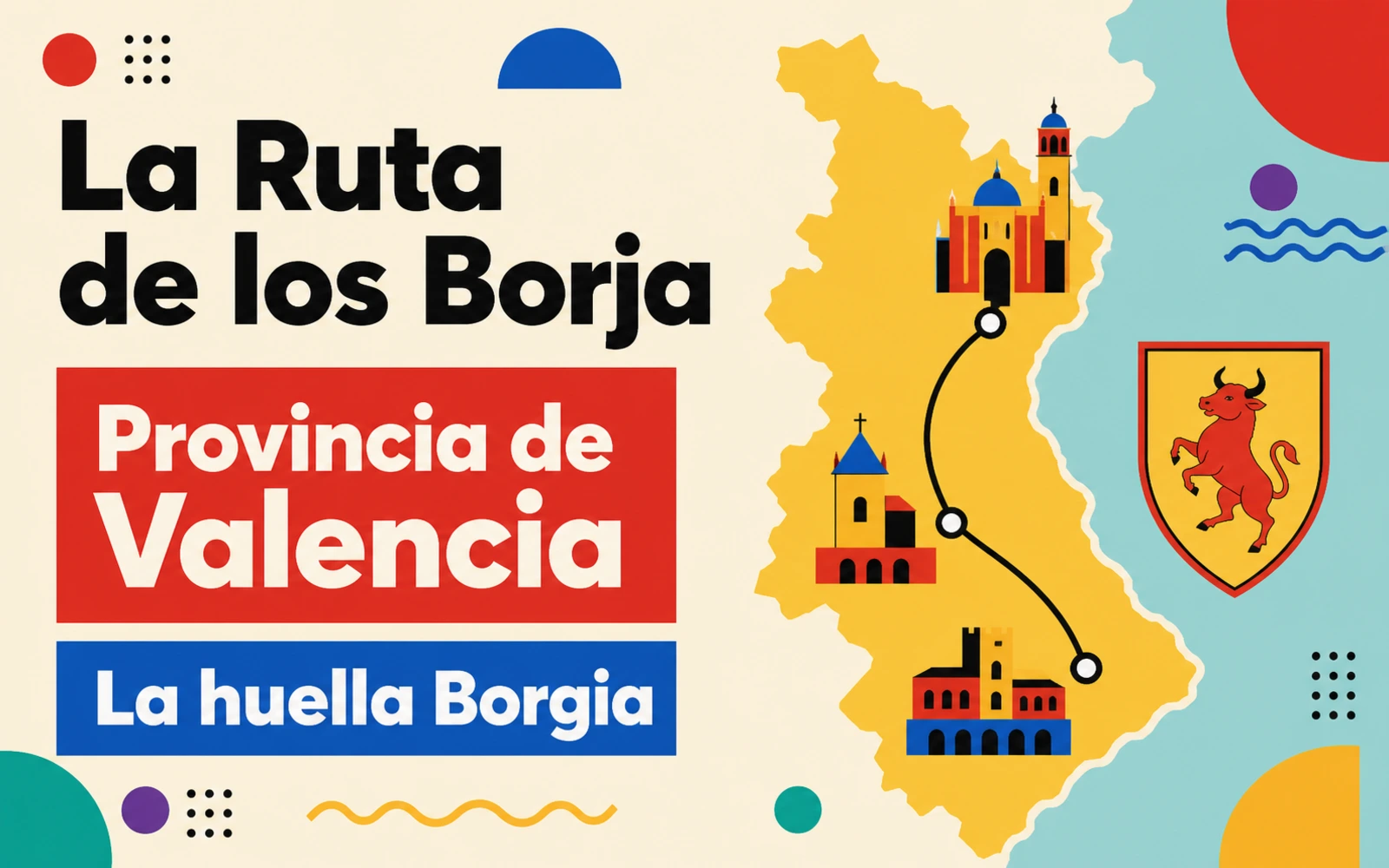

The Borgia Route through the province of Valencia is a cultural route inaugurated in 2007 that captures the mark and splendour of the most universal Valencian family, the Borjas or “Borgias”, in the Valencian Community.
Contents
The Borgia Family
The family settled in Valencian lands following the conquest of Valencia by James I.
Popes Calixtus III and Alexander VI, Cesare and Lucrezia Borgia and Saint Francis Borgia are the best-known members of “The House of Borgia”, one of the most influential families of the Renaissance.
From Canals and Xátiva, passing through Valencia, they reached Rome, later returning once again to Valencian lands to refound the Duchy of Gandia.
The Route
The route through the heritage of the Borgias starts in the city of Gandia and finishes in Valencia, visiting various Valencian monuments and towns where the Borgias left their mark.
The route, city by city
Gandia
- The Old University: founded by Francis Borgia. Beside the building you will discover the five bronze sculptures representing the most famous members of the family (work by Manuel Boix)
- The Collegiate Church of Santa María de Gandia : extended by María Enríquez de Luna, duchess regent of Gandia and daughter-in-law of Alexander VI.
- The Ducal Palace of Gandia: Most of the Borgia dukes and all their descendants were born here.
- The Hospital of San Marcos: whose board of trustees was chaired by the Dukes of Gandia, today houses the Archaeological Museum of Gandia.
- The Convent of Santa Clara: preserves an outstanding art collection bequeathed by the Borgias. It was a retreat convent for many women of the Borgia family.
- The Alquería del Duc: also known as the Alquería de Don Alonso, is a fortified farmhouse converted, in its time, into a stately leisure and hunting estate.
- The Pine Tower (Torreón del pino), from the sixteenth century, formed part of the wall expansion carried out by Francis Borgia
Alfahuir
- The Monastery of Sant Jeroni de Cotalba, founded in 1388 and located 8 kilometres from Gandia, enjoyed the protection of the Borgia family.
Simat de Valldigna
- The Monastery of Santa María de la Valldigna: Rodrigo de Borja and his son Cesare were abbots of this conventual building.
Albaida
- The Castle-Palace of the Milán de Aragón: Cardinal Luis de Milá y de Borja, nephew of Pope Calixtus III, built this palace-fortress in the centre of the municipality.
Castellón de Rugat
- Ducal Palace: some remains are preserved of a palace used by the Dukes of Gandia as a summer and leisure residence.
Canals
- Canals Tower: according to tradition, this is where Alfonso de Borja, the future Pope Calixtus III, was born.
- The Borgia Oratory: preserves a medieval panel painting depicting the Last Judgment.
Xátiva
- The Collegiate Church of Xátiva: Burial site of several family members; in its museum, you can admire works of art belonging to the Borgias.
- The birthplace of Alexander VI: is preserved in the square that bears his name.
- Church of San Pedro: where the future Pope Alexander VI was baptised in the year 1431.
- The Hermitage of Santa Ana: Saint Anne was the patron saint of the Borgia family.
Llombay
- The Church of the Holy Cross: forms part of the former Dominican convent. This convent was a donation from Saint Francis Borgia, first Marquess of Llombay. The annual Borgia Market takes place in Llombay.
Valencia
- Valencia Cathedral: Alfonso de Borja ordered the construction of the Chapel of Saint Peter. Rodrigo de Borja, before being proclaimed pope, commissioned an Italian painter to create the frescoes for the dome. In the chapel dedicated to Saint Francis Borgia, there are two canvases by Goya dedicated to the saint.
- The Borgia Palace: located just a few metres from the cathedral, it was erected by the first Duke of Gandia and son of Alexander VI, Pedro Luis de Borja. It is currently the seat of the Valencian Parliament.
- The University of Valencia: It was founded in 1500 thanks to the papal bull of Pope Alexander VI. In the University’s Estudi General, its impressive Renaissance cloister stands out.
- Church of San Nicolás: Calixtus III was rector here; tilework commemorates the prediction by Saint Vincent Ferrer according to which Alfonso de Borja would become pope and later canonise him.
Map
Here is a map showing all the places to visit on the Borgia Route through the province of Valencia.