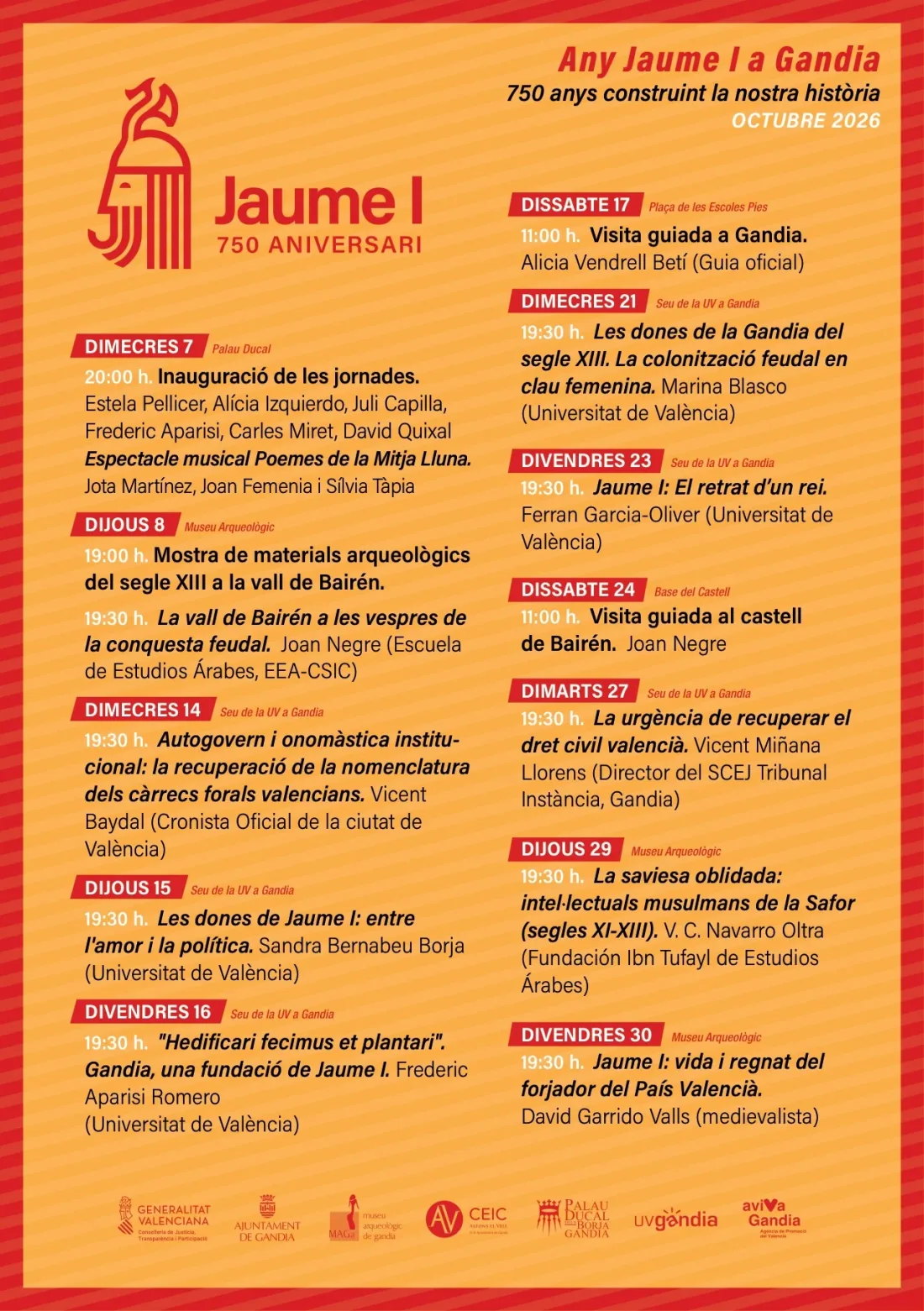
From 7 to 30 October 2026, Gandia devotes an entire month to King Jaume I to mark the 750th anniversary of his death: talks, an archaeological display, two guided tours and a show of medieval poetry and music, spread across the Palau Ducal, the Museu Arqueològic, the Universitat de València’s Gandia centre and Bairén Castle.
Contents
The programme goes by the name Any Jaume I a Gandia and the motto 750 anys construint la nostra història (750 years building our history). It forms part of the commemoration declared by the Valencian regional government, the Generalitat Valenciana, for the whole of 2026, the year that marks seven and a half centuries since the death of the monarch, who died on 27 July 1276. In Gandia it is organised by the City Council, the CEIC Alfons el Vell and the Centre Internacional de Gandia of the Universitat de València, with the support of other institutions and cultural organisations in the city.
The programme reaches well beyond the king’s biography. It looks at the 13th century as a whole: how the territory was organised after the conquest, who lived in the Bairén valley before and after the arrival of the new settlers, what role women played in medieval society and what legacy the Muslim scholars of La Safor left behind. It is a good opportunity to get to know Gandia’s medieval origins, with university specialists and tours on the ground. Please note that all events in the programme are held in Valencian.
Jaume I, Bairén and the birth of Gandia
The king’s link with the area runs through Bairén Castle, the Andalusi fortress overlooking the plain from the Sant Joan hill. Around 1239-1240, the castle surrendered on agreed terms to the troops of Jaume I, and records already place several of the monarch’s land grants within its district in 1240, followed by further measures to organise the territory now occupied by Gandia and its surroundings.
After the surrender, the population gradually moved from the hill down to the farmstead on the plain, the seed of the medieval town that would eventually shape today’s Gandia town centre. If you would like to learn the story in more detail, our blog covers the move from Bairén to the medieval town in the time of Jaume I. The October programme returns to the subject from several angles: the archaeology of the valley, the founding of the city and the lives of those who settled it.
Opening at the Palau Ducal with Poemes de la Mitja Lluna
The programme opens on Wednesday 7 October at 20:00 at the Palau Ducal dels Borja. After the official opening ceremony, the stage is given over to Poemes de la Mitja Lluna (Poems of the Half Moon), a poetry and music show that explores Andalusi poetry and the Muslim cultural legacy, a fitting starting point for a programme that looks at both sides of the conquest.
On stage will be Jota Martínez, a specialist in medieval music and in the recovery of historical instruments; the poet and reciter Joan Femenia; and the teacher and reciter Sílvia Tàpia.
The Bairén valley at the Museu Arqueològic
On Thursday 8 October, the Museu Arqueològic de Gandia (MAGa) opens at 19:00 a display of 13th-century archaeological finds from the Bairén valley. These objects, recovered in the valley, offer a glimpse into the daily life of medieval society through its material remains.
Then, at 19:30, archaeologist Joan Negre, of the School of Arabic Studies (EEA-CSIC), gives the talk La vall de Bairén a les vespres de la conquesta feudal (The Bairén valley on the eve of the feudal conquest), focusing on what the valley was like just before the arrival of Jaume I. The MAGa also hosts the two sessions that close the programme at the end of the month.
Talks at the Universitat de València centre
Most of the programme takes place at the Seu de la UV a Gandia, always at 19:30. The titles are given in Valencian, as they appear in the official programme:
- Wednesday 14 October: Autogovern i onomàstica institucional: la recuperació de la nomenclatura dels càrrecs forals valencians (self-government and the recovery of the names of the historic Valencian offices), with Vicent Baydal, official chronicler of the city of València.
- Thursday 15 October: Les dones de Jaume I: entre l’amor i la política (the women of Jaume I, between love and politics), with Sandra Bernabeu Borja (Universitat de València).
- Friday 16 October: «Hedificari fecimus et plantari». Gandia, una fundació de Jaume I (Gandia, a foundation of Jaume I), with Frederic Aparisi Romero (Universitat de València).
- Wednesday 21 October: Les dones de la Gandia del segle XIII. La colonització feudal en clau femenina (the women of 13th-century Gandia and feudal settlement from a female perspective), with Marina Blasco (Universitat de València).
- Friday 23 October: Jaume I: el retrat d’un rei (portrait of a king), with Ferran Garcia-Oliver (Universitat de València).
- Tuesday 27 October: La urgència de recuperar el dret civil valencià (the urgent need to restore Valencian civil law), with Vicent Miñana Llorens, director of the SCEJ at Gandia’s Court of First Instance.
The two talks devoted to women are one of the highlights of the programme: the first deals with the women who shaped the king’s life, between affection and politics; the second moves to the local scale and looks at the feudal settlement of Gandia through women’s experience. The talk on the 16th, whose Latin title refers to the act of building and planting, tackles head-on the city’s origins as a royal foundation.
Two guided tours of medieval Gandia
On the two middle Saturdays of the month the programme heads outdoors, both times at 11:00:
- Saturday 17 October: guided tour of Gandia, starting from the Plaça de les Escoles Pies and led by official guide Alicia Vendrell Betí. The route focuses on the Gandia of its founding years.
- Saturday 24 October: guided tour of Bairén Castle, meeting at the foot of the castle, led by Joan Negre, the same archaeologist who opens the programme at the MAGa.
For the climb up to Bairén, comfortable footwear and water are a good idea: the castle sits on top of a hill, and the views over La Safor and the sea make the effort worthwhile. If you fancy it, you can also walk up to the castle on your own another day.
Closing at the MAGa with Andalusi La Safor and the king
The final week returns to the Museu Arqueològic, again at 19:30:
- Thursday 29 October: La saviesa oblidada: intel·lectuals musulmans de la Safor (segles XI-XIII) (forgotten wisdom: Muslim scholars of La Safor, 11th-13th centuries), with V. C. Navarro Oltra, of the Ibn Tufayl Foundation for Arabic Studies.
- Friday 30 October: Jaume I: vida i regnat del forjador del País Valencià (life and reign of the forger of the Valencian lands), with medievalist David Garrido Valls, who brings the programme to a close.
The penultimate session brings back the scholars and men of letters who lived in the area in the Andalusi period, a part of local history less familiar to the general public. The closing talk, by contrast, returns to the figure of the monarch to offer an overview of his life and reign.
A programme for schools and families too
Alongside the activities open to the public, the City Council has prepared specific teaching materials for schools, adapted to different ages and accompanied by educational activities, literary routes and proposals to bring history closer to younger children. One of the main threads is the Llibre dels fets (Book of Deeds), the chronicle of the reign of Jaume I, regarded as one of the great works of medieval literature and a valuable source for tracing the development of the language.
Practical information
- Dates: 7 to 30 October 2026.
- Language: all events, including the guided tours, are in Valencian.
- Times: opening at 20:00; archaeological display at 19:00; talks at 19:30; guided tours at 11:00.
- Venues: Palau Ducal dels Borja, Museu Arqueològic de Gandia (MAGa), Seu de la UV a Gandia, Plaça de les Escoles Pies and the foot of Bairén Castle.
- Organisers: Ajuntament de Gandia, with the CEIC Alfons el Vell and the Centre Internacional de Gandia of the Universitat de València.
Admission arrangements for each event, including any registration for the guided tours, have not yet been announced. It is worth checking beforehand on the Gandia City Council website or through the channels of the Palau Ducal and the MAGa. Hotel Borgia is right in the centre, a few minutes’ walk from the Palau Ducal and the Museu Arqueològic, so you can combine several sessions with a stroll around the old town.