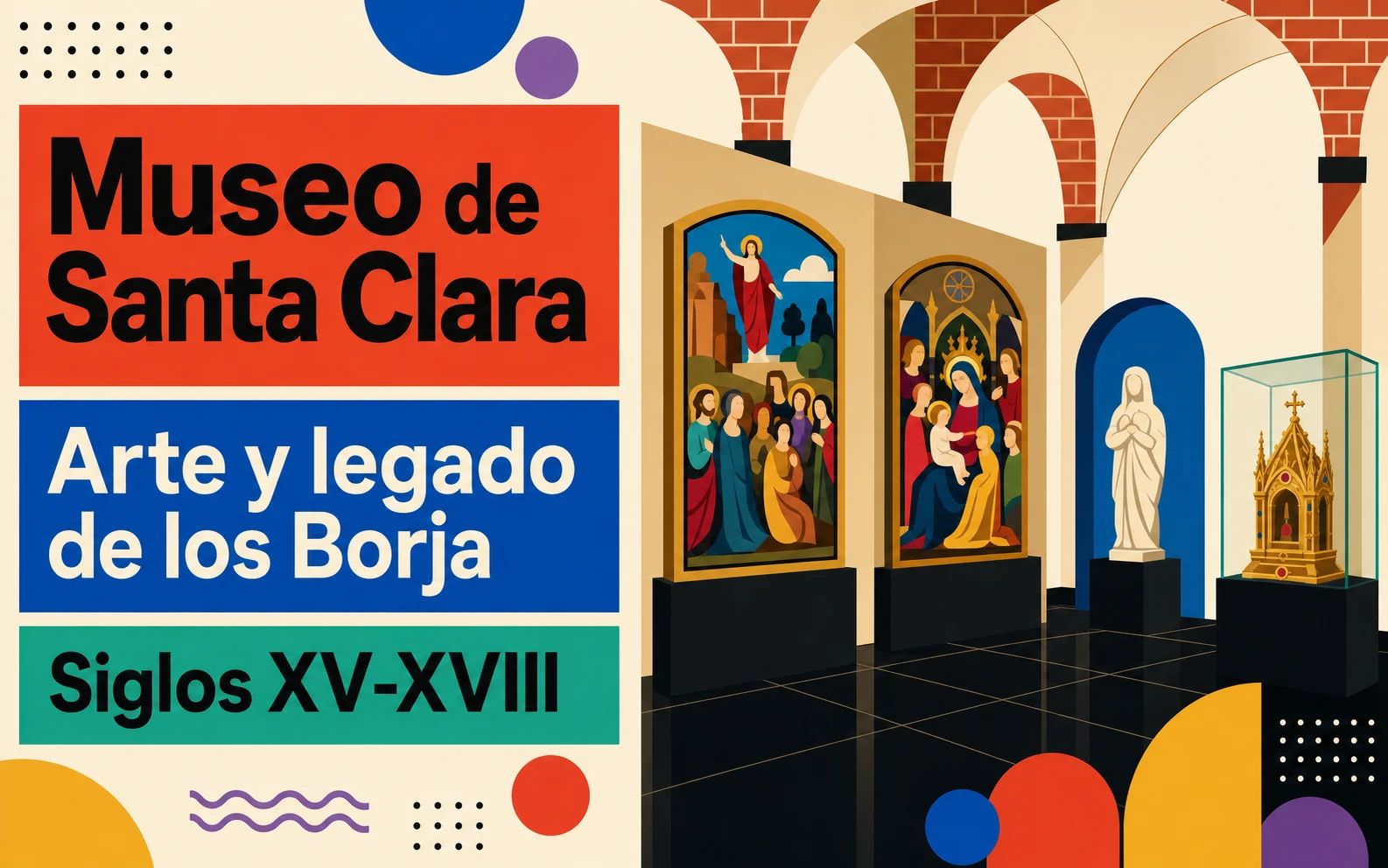
The Museu de Santa Clara in Gandia brings together the artistic treasure that the Poor Clares have kept for almost six centuries in their enclosed convent: Gothic and Renaissance panels, a Ribera, reliquaries, silverwork and the Franciscan cord linked to the birth of Saint Francis Borgia. It is housed in the Sala d’Hòmens of the old Hospital de Sant Marc, in the heart of the Centre Històric, and it is one of the most revealing stops for understanding the bond between the women of the ducal house and the town.
Contents
A convent founded by the duke’s daughter (1428-1457)
The museum’s story begins with Violant d’Aragó, daughter of Alfons el Vell, the first royal duke of Gandia, who in 1428 promoted the foundation of a convent of Poor Clares in the town. The privilege that consolidated the community was granted by the abbot of the Monastery of Valldigna on 7 May 1431, and a second privilege, dated 11 May 1457, introduced the reform of Saint Colette of Corbie: since then the nuns of Gandia have been Colettine Poor Clares, following the strict rule. The three dates explain why some sources speak of 1428, others of 1431 and others of 1457; the parchments of those privileges are among the items on display in the museum.
The Borgia women behind the cloister
The convent became the spiritual refuge of the women of the ducal house. Isabel de Borja, daughter of the second dukes, took her vows as Sister Francisca de Jesús, and her mother, María Enríquez de Luna, the duchess who had governed the duchy during her son’s minority, made her will in February 1512 and entered Santa Clara as Sister Gabriela. She was abbess in two periods, the first between 1514 and 1519, interrupted by the Revolt of the Germanies, and again from 1530.
Later came several sisters of Saint Francis Borgia and one of his daughters, also called Isabel. Sister Francisca de Jesús herself, author of a set of Exhortations to the nuns, was chosen by Princess Joanna of Austria to help found the Descalzas Reales convent in Madrid. Every profession brought dowries, commissions and donations: that is how, piece by piece, the collection on show today came together.
From convent to museum
The works remained inside the enclosure for centuries; the Poor Clares safeguarded them even during the Civil War. In 2010 the community signed a loan agreement with Gandia Town Council to put them on public display, and in March 2015 the Museu de Santa Clara opened in the Sala d’Hòmens of the old Hospital de Sant Marc, the 14th-century Gothic hall that shares the complex with the Gandia Archaeological Museum (MAGa). The pieces remain the property of the Poor Clares and are exhibited on loan; some of them are studied and restored with the Heritage Restoration Institute of the Universitat Politècnica de València.
What to see in the collection
The visit covers painting, sculpture, silverwork and documents, with the Gothic architecture of the hall itself as the first attraction. These are the pieces not to miss:
- Panels by Paolo da San Leocadio, the Italian painter linked to María Enríquez’s patronage, with the Adoration of the Shepherds, the Adoration of the Magi and The Ascension.
- The Death of Saint John the Evangelist, a panel attributed to Nicolau Falcó, from around 1515-1520.
- Works from the workshop of Vicent Macip and Joan de Joanes: the Altarpiece of the Annunciation and the restored panel of the Crucifixion, from around 1530.
- José de Ribera’s Saint John the Baptist, a Baroque canvas of Caravaggesque chiaroscuro.
- Ecce Homo and Our Lady of Sorrows, a pair of 17th-century polychrome carvings attributed to the workshop of Pedro de Mena.
- Ten reliquary busts in gilded and polychrome wood from the 16th century, plus monstrances, chalices and noble jewellery.
- The Franciscan cord which, according to tradition, Juana de Aragón borrowed from the Poor Clares for protection during the difficult birth of her son, the future Saint Francis Borgia, in 1510.
- The foundation parchments with the privileges of 1428, 1431 and 1457.
Among the paintings there is also a supposed portrait of Duchess Leonor de Castro, wife of Francis Borgia, and a Saint Francis Borgia, which close the circle between the museum, the Palau Ducal where the saint was born and the Collegiate Church that his grandmother enlarged.
Opening times, tickets and guided tours
The museum is open from Tuesday to Sunday and closed on Mondays. From September to June, Tuesday to Saturday from 9:00 to 19:00 and Sundays from 10:00 to 14:00; in July and August, Tuesday to Saturday from 10:00 to 20:00 and Sundays from 10:00 to 14:00. A standard ticket costs €2.50, reduced €1.50, and children under 6 go free. One-hour guided tours (€2.50 per person, ticket included) run on Friday afternoons and Saturday mornings, with advance booking for groups of 10 or more. Times and prices may change: check them on the museum’s official website or the XEC Gandia page.
How to get there and what to combine it with
The Museu de Santa Clara is at Carrer de l’Hospital, 20-22, beside the Serpis and the old town walls, a few minutes’ walk from the railway station and the Palau Ducal (see on Google Maps). The natural combination is to visit the MAGa in the same building and carry on to the Palau Ducal and the Collegiate Church; if you come with the La Visit Gandia card, check which sites it includes. The museum is one of the five must-see places in the town centre and a good starting point for the “Borgia Territory” urban route.