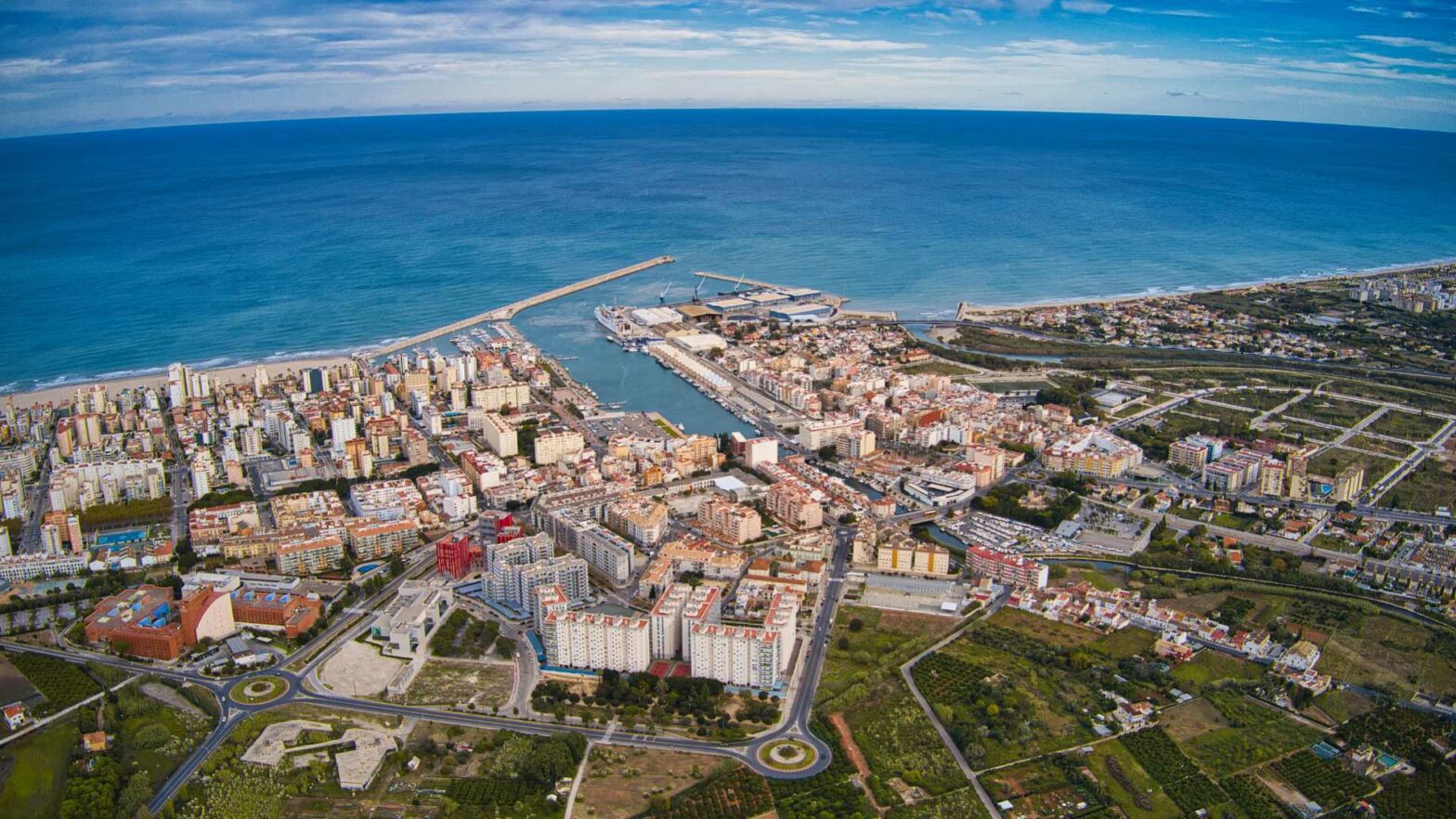
The history of Gandia runs from the Upper Palaeolithic of the Cova del Parpalló to today’s capital of the Safor, by way of the Moorish castle of Bairén, the medieval town of Jaume I, the Borgia court and the orange-shipping port. The article orders it by period and links, in each one, the places where it can still be visited.
Contents
Few towns of its size concentrate so much visitable history; each section points to the blog guide that expands on the corresponding monument or figure.
The first inhabitants: from the Parpalló to the MAGa
The oldest human remains in the area were found in the Cova del Parpalló, which held one of the world’s largest collections of Palaeolithic portable art: more than 5,000 engraved and painted stone plaquettes. The Cova de les Meravelles and the Cova del Bolomor complete the region’s prehistoric chapter. A good part of the finds is on display at the Archaeological Museum of Gandia (MAGa), housed in the former Hospital de Sant Marc; the interior of the Parpalló can only be visited on guided trips with prior booking.
Bairén, Moorish Gandia
In the Andalusi period the territory was organised around the Castell de Bairén and a network of farmsteads on the Serpis plain, among them Beniopa, Benipeixcar and Benirredrà. In 1097 its slopes hosted the Battle of Bairén, where Rodrigo Díaz de Vivar, El Cid, and Peter I of Aragon defeated the Almoravids; the chronicle Historia Roderici contains the first written mention of the castle. The guide to Bairén Castle details the walk up to the archaeological park and the remains preserved there.
Jaume I and the birth of the town
The Christian conquest concluded between 1239 and 1240, when the Muslim governor handed the castle over to Jaume I under a negotiated surrender. The place name appears in writing in 1249 in the Llibre del Repartiment, under the spellings Candia or Candie, and the population gathered in a new walled town on the plain, the seed of today’s Centre Històric. The post on Jaume I and Gandia expands on the move from the castle to the town.
The Royal Duchy and the court of Alfons el Vell
In 1323 James II granted the lordship of Gandia to the infante Pere d’Aragó, and in 1399 Martin I the Humane raised it to a Royal Duchy for Alfons el Vell, who lived in the town. His rule drove the beginnings of the Palau Ducal, the founding of the Hospital de Sant Marc and the start of the Gothic church of Santa María in 1372; the Corpus Christi of Gandia has been documented since 1391. The post on the Duchy of Gandia follows the title’s full trajectory.
The golden age of Valencian letters
During the 15th century the ducal court drew the great names of literature in Valencian. Ausiàs March (1397-1459), lord of Beniarjó, Joanot Martorell, author of Tirant lo Blanch, and Joan Roís de Corella (1435-1497) form the roll of authors that ties the Valencian golden age to Gandia and the Safor.
The Borgias, from Rome to Gandia
On 20 December 1485 Cardinal Rodrigo de Borja, the future Pope Alexander VI, bought the duchy from Ferdinand the Catholic for his son Pedro Luis, the first Borgia duke. After Pedro Luis died in 1488, the title passed to his brother Juan, married to María Enríquez de Luna, regent of the duchy and driving force behind the Collegiate Church of Santa María, raised to collegiate rank in 1499.
Francis Borgia and the first Jesuit university
In 1510 the future Saint Francis Borgia was born in the Palau Ducal dels Borja: fourth Duke of Gandia, Viceroy of Catalonia and third Superior General of the Society of Jesus, canonised in 1671. He strengthened the town walls and promoted a college that the bull of Paul III of 4 November 1547 turned into the University of Gandia, opened in 1548 and the first in the world run by the Jesuits.
Sugar, the Moriscos and the crisis of 1609
The 15th and 16th centuries were also the age of sugar cane, pressed in the trapigs of farming estates such as the Torre dels Pares, rebuilt by the Jesuits in the 16th century. The expulsion of the Moriscos decreed by Philip III in 1609 left the duchy without the workforce behind the sugar economy and opened a long period of crisis, seigneurial bankruptcy and depopulation; the dukes eventually moved their residence to Madrid.
From silk to oranges: the port and the tren dels Anglesos
Recovery came in the 18th century, under the reign of Charles III: in 1772 the Town Hall’s neoclassical façade was built. In the 19th century, after the silk crisis, oranges took over and demanded infrastructure: work on the port began in 1886 and the Alcoy-Gandia railway, the popular tren dels Anglesos, was officially opened on 24 January 1893, operated by a British company. The post on El Grau de Gandia tells the seafaring life of the harbour district, and the old railway corridor can be followed today along the Serpis Greenway.
The 20th century: war, tourism and a bigger city
During the Spanish Civil War the port and the town centre suffered bombing raids, and the population took shelter in the air-raid shelters of Gandia, including the one under Plaça del Prado, now partly turned into a museum space. From the 1960s came sun-and-beach tourism and the rapid urbanisation of the Playa de Gandia; in 1965, Beniopa and Benipeixcar were annexed to the municipality and are neighbourhoods of Gandia today.
How to visit each period today
To organise a visit to the Centre Històric, the «Territorio Borgia» urban route is very useful, and the La Visit Gandia card groups admission to the main cultural sites. Opening times, fees and guided visits change with the season; check them on the official Visit Gandia website before planning your day.